
If you are trying to figure out how to potty train a French Bulldog while your puppy stares at you like, “Yes, I heard you, and no,” you are not alone. Frenchies can pick this up surprisingly fast when the conditions are right, but they are also famously opinionated, easily distracted, and deeply offended by cold grass, drizzle, and anything that interrupts a nap. The breed’s stubbornness is real, but it is not the main reason people struggle. The main reason is giving a puppy too much indoor freedom too soon.
When I brought Nina home I did what most people do: read a lot of advice, felt prepared, then got immediately humbled by a tiny dog with a big personality and zero interest in my schedule. What finally worked was not more effort, it was a tighter routine, less unsupervised indoor access, and rewards timed so clearly that Nina could not pretend she did not understand. Once those three things lined up, the accidents dropped fast.
Key takeaways
- Most French Bulldogs take 4 to 6 months to become reliably potty trained, and some go longer
- Tight supervision and smart confinement prevent more accidents than any amount of correction
- Reward the right behavior immediately and consistently, because timing is what makes the lesson stick
How long potty training actually takes with a Frenchie
Nina took close to five months before I felt genuinely confident, and even then I was holding my breath for a few weeks after that. Some Frenchies start clicking around the three-month mark. Others are still working through it at seven or eight months. Both are normal. The AKC’s French Bulldog puppy training timeline makes the point that early consistency matters more than how quickly the puppy progresses, because you are building a habit that has to hold under real conditions, not just ideal ones.
What tends to speed things up
- Starting the routine on day one, not “once she settles in”
- Using a crate or gated area any time you cannot watch closely
- Rewarding the moment the potty happens outside, not after you get back inside
- Keeping the schedule identical on weekends and weekdays
The biggest shortcut I found was not getting creative. Same door, same spot, same cue word, same reward, every single time. Frenchies are pattern animals, and the faster the pattern becomes familiar, the faster the habit forms.
What tends to slow things down
- Letting a young puppy roam freely before they have actually earned that access
- Trips outside that happen whenever someone remembers rather than on a real schedule
- Reacting to accidents with frustration, which teaches hiding rather than going outside
- Switching between outdoor training and puppy pads without committing fully to one method
Switching methods mid-training is probably the thing I see slow people down the most. The puppy is not confused about the rules. They have just been shown two different sets of them.
How often to take a French Bulldog out by age
Young puppies have almost no bladder control, and expecting them to hold it longer than their age allows is where most accidental damage to the training routine happens. If accidents are still frequent, the gap between trips is usually the explanation.
- 8 to 10 weeks: every 45 to 60 minutes when awake; also after waking, eating, drinking, and playing, and before crating
- 10 to 12 weeks: every 60 to 90 minutes when awake; same triggers plus any circling or sniffing
- 3 to 4 months: every 90 minutes to 2 hours when awake; after naps, meals, play, and before more indoor time
- 5 to 6 months: every 2 to 3 hours when awake; after meals and big play sessions
A rough rule is that a crated puppy can hold it for about one hour per month of age. I treated that as a ceiling, not a target. Nina could sometimes stretch it a little, but the moment something exciting happened, that ceiling dropped fast. Diet plays into this timing too, because what you feed your Frenchie affects how quickly meals move through them and how predictable the post-meal window actually becomes.
The potty training loop that works for Frenchies
When people ask what I actually did with Nina, this is it. It is repetitive by design. The habit forms because of the repetition.
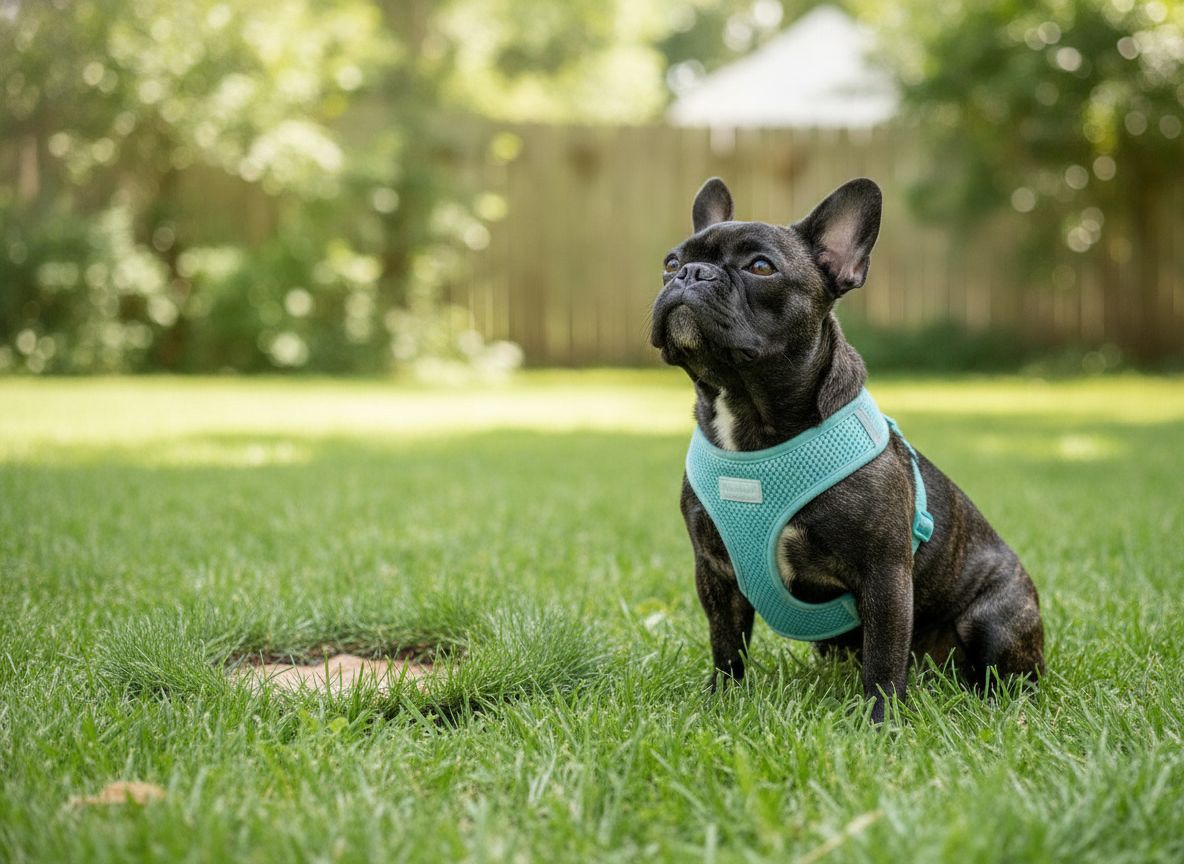
- Wake up and go straight outside. No breakfast first, no detour to say good morning, no letting the puppy wander while you make coffee. Clip the harness you use for every potty trip and go directly to the spot. Using the same harness every time helps signal this is a working trip, not a play walk. This is the most important trip of the day because the bladder has been held overnight and accidents happen within minutes of waking.
- Stand still at the potty spot. If you move around, your Frenchie thinks it is time to explore. Plant yourself in one place, let the sniffing happen, and say your cue word once, softly, as they begin to go. Not before. Not after. During.
- Reward the second they finish. Not when you get back inside, not after thirty seconds of praise. A small, soft treat they genuinely want needs to land within two or three seconds of the potty finishing so the connection is clear. If your Frenchie is more motivated by play than food, a short tug with a toy they are actually excited about right at the potty spot works just as well. The reward vehicle matters less than the timing.
- Supervise or confine when back inside. Freedom is earned in steps. After a successful outdoor trip, Nina got supervised indoor time. If I could not watch her, she went to her safe space. That structure was not punishment. It was what kept the accident count low enough for the habit to build cleanly.
- Hit every trigger trip. Out after every nap. Out after every meal and big drink. Out during and after active play. Out before crating and before bed. These trips catch the majority of accidents before they happen, which is always better than cleaning them up after.
Using a crate as a potty training tool
When I first used a crate with Nina I worried it would feel harsh. What I found pretty quickly is that when introduced right, most Frenchies take to a crate without much resistance, and it became one of the most useful tools in the whole process. The reason it works for potty training is simple: dogs naturally avoid soiling where they sleep. A properly sized crate gives your puppy a strong reason to hold it until you take them outside.
The size matters more than most people realize. Too large and your puppy will eliminate in one corner and sleep in the other, which removes the whole point. A crate that fits a Frenchie correctly gives them room to stand, turn around, and lie down comfortably, nothing more during the early training months. You can always upgrade as they grow.
A few rules that keep the crate working as a potty tool:
- Take them outside to potty immediately before every crate session, every single time
- Take them outside to potty immediately after every crate session, before anything else happens
- If they cry or whine during a daytime session, treat it as a potty request first and take them out quietly
- Never crate as a reaction to an accident, because the crate needs to stay a calm and neutral space
Keeping the crate experience consistent and positive is what makes it useful long-term. A puppy that dreads the crate loses it as a management tool exactly when you need it most.
Reading your Frenchie’s potty signals
One thing Nina taught me early is that Frenchies can go from playing happily to squatting in a corner in about four seconds. There is almost never a clear “I need to go” pause. The signal is usually subtle, and catching it in time is mostly about knowing what to watch for before things get urgent.
Signs that usually mean a potty trip needs to happen right now:
- Sniffing the floor in a slow, deliberate tracking pattern
- Tight circling in a small area, sometimes getting progressively tighter
- Suddenly stopping play and going quiet
- Drifting toward a spot where an accident happened before
- Low-level restlessness or pacing after having been calm
- A quick motionless sniff followed immediately by a squat, which happens fast in young puppies and leaves almost no reaction time
When you see any of these, move immediately. Carry young puppies to the spot if you need to. A consistent verbal cue said calmly as you head to the door builds a conditioned response over time, but in the early weeks you are acting on the signals, not waiting for the puppy to ask. The signals become easier to read once you know your individual dog. Nina’s tell was always the floor sniff, and once I recognized it, I almost never missed the window.
Nighttime potty training
Nighttime is where routines get worn down, so the goal is to keep it as boring as possible. Young puppies often need at least one overnight trip in the first weeks. The key is to make that trip feel like nothing: lights low, no talking beyond a quiet cue word, potty, straight back to sleep. If it becomes exciting, you will teach your puppy that 2 a.m. is a fun time to be awake.
The nighttime routine
- Last potty trip right before bed, after the puppy has calmed down from any evening play
- Crate close enough to hear if they whine overnight
- If they wake and cry, take it seriously as a potty request in the early weeks rather than waiting it out
- Reward the overnight trip just as you would any other, then immediately back to the crate
- Stretch the overnight gap gradually only after multiple dry nights in a row
With Nina, the trick was not toughing it out until she could hold it longer. The trick was making nighttime potty so unremarkable that she stopped using it as a reason to start the day at 2 a.m. Boring and consistent works.
Cold weather, rain, and apartment situations
When your Frenchie refuses to go outside
Frenchies are famously dramatic about wet grass, cold paws, and anything that feels mildly uncomfortable. A refused potty trip followed by full indoor freedom is a recipe for an accident ten minutes later. The short-and-repeat method prevents this: go to the spot, stand still for 3 to 5 minutes, and if nothing happens, go inside and confine for 10 to 15 minutes, then try again. No free indoor roaming between an unsuccessful trip and the next attempt.
Apartment potty training
The challenge in an apartment is the distance between your door and the potty spot, because young puppies have almost no warning time and a long hallway or elevator ride is a lot to ask at 8 weeks. In the early weeks, carrying your puppy down rather than walking them is worth doing if you can manage it. Use the same exit and the same path every trip so the route itself becomes part of the cue. Save any outdoor sniffing or exploration for after the potty has happened, because sniffing on the way down is how you end up with a puppy who goes in the elevator.
Managing indoor freedom
Whether you are in a house or an apartment, indoor access should expand in small, tested steps. One clean week does not mean your Frenchie is ready for unsupervised access to every room. Add one area at a time and be willing to pull it back without drama if accidents start appearing again. It is not a regression. It just means the habit needs more repetitions in a smaller controlled space before that new area is ready to open up.
How to handle potty training accidents
Every accident is information before it is a frustration. Almost all of them mean the schedule had a gap, supervision slipped, or the puppy had more indoor freedom than the habit could support yet. The American Veterinary Society of Animal Behavior is consistent on this: punishment-based responses do not teach a puppy where to go. They teach them to find a spot where they will not be seen. The training gets slower, not faster.
If you catch it happening: pick up a young puppy calmly and move them to the potty spot. Give them a chance to finish outside and reward if they do.
If you find it after the fact: clean it up without reaction, think back to where the schedule or supervision slipped, and tighten that gap.
On cleaning: dogs return to spots they have used before because of residual scent that regular household cleaners do not fully remove. An enzymatic cleaner breaks down those odor compounds at the source. Let it dry completely and block access to repeat-accident spots while the habit is still forming.
Accidents during early training are not signs that something is wrong with your dog or your approach. A week with no accidents does not mean potty training is finished. It means it is working, which is a different thing entirely.
Common mistakes that stall potty training
The Frenchies who take longest to train are almost never the problem. It is almost always a management issue that keeps accidents going long enough to prevent the habit from setting.
- Too much indoor freedom too soon. One good day is not a reliable habit. One good week is not a reliable habit. Expanding access slowly is what makes the pattern actually stick.
- Waiting for the puppy to ask. Young puppies often cannot communicate the need to go out until the habit is almost fully formed. Early on the schedule drives the trips, not the puppy’s behavior.
- Turning potty trips into outdoor exploration. A Frenchie who learns that stalling outside means more sniffing time will stall outside on purpose. Potty first, then play. Every time.
- Punishing accidents. This sets training back more than almost anything else. A puppy punished for accidents does not connect the punishment to the act. They connect it to being found.
- Different rules between people in the house. If one person follows the routine strictly and another lets the puppy roam freely, the puppy figures out the rules are negotiable and pushes on them constantly.
None of these mistakes mean starting over. Correcting the management gap and running the routine cleanly for two to three consistent weeks will usually get things moving again.
When something feels off, check with your vet
Sometimes what looks like a training plateau is actually a physical issue. A UTI creates urgency that a dog genuinely cannot control, and from the outside it can look completely identical to a regression in a dog who was doing well. Before adjusting training schedules or going back to basics, it is worth a vet call if the change is sudden and nothing about the routine explains it.
Situations worth a vet call rather than a training adjustment:
- Sudden regression in a dog that was doing well, with no obvious change in schedule or environment
- Straining or crying during urination, very frequent small urinations, blood in the urine, or an unusually strong odor
- Accidents that seem to happen without the dog noticing or being able to stop
- Excessive thirst paired with noticeably more urination than usual
- Loose stool with blood, vomiting, lethargy, or signs of dehydration
- New accidents in an adult dog who was reliably trained, especially alongside any change in energy, appetite, or water intake
A physical problem caught early is almost always a faster fix than weeks of adjusted training that was never going to solve the real problem. When the timeline feels genuinely off relative to how consistent the routine has been, ruling out a medical cause is always the right first move.
FAQ: potty training a French Bulldog
How long does it take to potty train a French Bulldog?
Most Frenchies reach real reliability somewhere between 4 and 6 months of consistent training, with some going longer. Early and consistent routines matter more than the puppy’s age at start.
Are French Bulldogs harder to potty train than other breeds?
They can feel harder because they are routine-dependent, opinionated about surfaces and weather, and easily distracted. But the core challenge is almost always management, not stubbornness. Frenchies learn quickly when accidents are prevented and the right behavior is rewarded immediately.
How often should I take my French Bulldog puppy outside?
At 8 to 10 weeks, every 45 to 60 minutes when awake, plus after every nap, meal, drink, and play session. The frequency decreases as the puppy gets older and builds more bladder control.
Should I use puppy pads or go straight to outside?
Either works, but switching between the two during training creates confusion. Pick a method based on your living situation and commit to it long enough for the habit to form, which is at minimum several weeks.
My Frenchie pees right after we come back inside. Why?
Most often it is distraction outside. Young puppies do not fully empty their bladder when they are busy scanning and sniffing the environment. Stand still at the potty spot and keep outdoor time boring until the potty happens. Rewarding outside rather than after you get back in also helps close this loop.
What is the fastest way to potty train a French Bulldog?
Fewer accidents. Every accident that happens inside is a rehearsal of the wrong habit. Tight supervision, smart confinement when you cannot watch, and immediate rewards after the right behavior outside is what produces fast results.
My Frenchie suddenly regressed. Is that normal?
Short backslides happen and are often triggered by routine changes, a new environment, growth spurts, or teething. But sudden regression after a dog was reliably trained can also be a sign of a medical issue like a UTI, so it is worth a vet call if the change is abrupt or persistent.
Can I potty train an adult French Bulldog?
Yes. Adult dogs can learn the same routine, sometimes faster than puppies because they have better bladder control. The method is the same: schedule, supervision, immediate rewards, and preventing accidents during the learning phase.
What do I do when my Frenchie refuses to go outside in the rain?
Go to the spot, stand still, and wait. If nothing happens after a few minutes, go inside and confine rather than giving free indoor access. Try again shortly after. Never reward coming inside with freedom after a failed outdoor trip, or the refusal becomes a strategy.