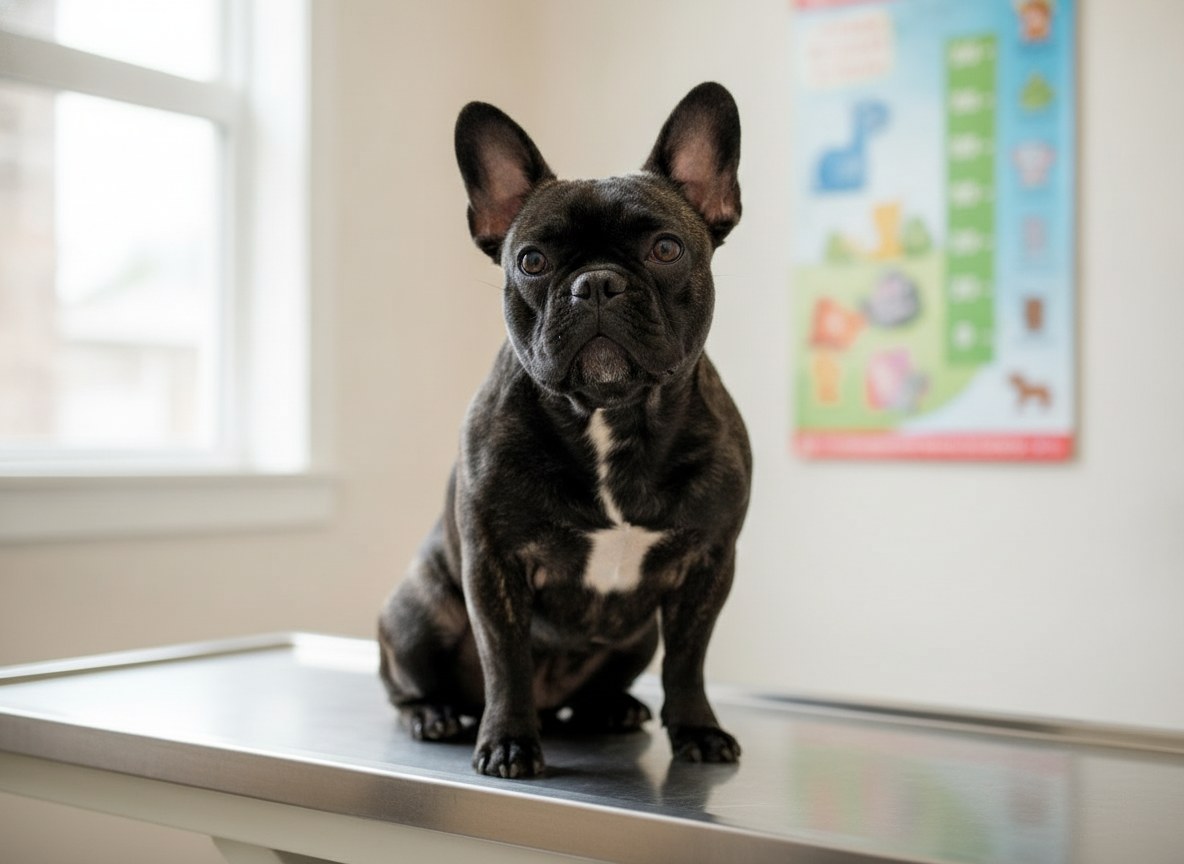

Somewhere in my phone there’s a photo of Nina at ten weeks old, sitting in a mixing bowl on the kitchen scale because she wouldn’t hold still on it any other way. Four and a bit pounds of pure attitude.
I weighed her almost weekly that first year, half out of curiosity, half out of new-parent anxiety. If you’re doing the same thing right now, here is how I would keep a growth record without treating another puppy’s weight as a target. For height and adult build, start with how big Frenchies get.
Key takeaways
- Track your puppy’s own weight over time rather than chasing a breed-wide monthly target.
- Choose a validated growth chart with your vet; male and female charts use estimated adult size.
- Do not restrict a growing puppy to meet a number. Appetite changes, weight loss or an unusual trend deserve advice.
French Bulldog weight chart by month
There is no single monthly weight that every healthy male or female Frenchie should meet. Nina’s four-and-a-bit-pound weigh-in at ten weeks is her story, not a target for another puppy. A table of precise breed-wide ranges can look reassuring while giving a misleading answer.
The WALTHAM puppy growth charts use sex and estimated adult weight categories. Ask your vet which chart to use and how to interpret the trend. The record below is a worksheet for your puppy, not a population weight standard.
| Age | Weight to record | Useful context |
|---|---|---|
| 8–12 weeks | Your puppy’s measured weight and date | Previous records, appetite and current food |
| 3–4 months | Repeat measurements on a consistent scale | Growth trend and any change in meals |
| 5–6 months | Keep plotting the individual curve | Ask about an unexpected change; do not force a target |
| 7–9 months | Continue the same record | Note health, activity and feeding changes |
| 10–12 months | Review the trend with your vet | Discuss growth and when to change food |
| Adult | Maintain a reference weight | Assess body condition and changes over time |
Swipe or scroll sideways to see all columns.
Record pounds or kilograms consistently. To convert pounds to kilograms, divide by about 2.205. The AKC’s 28-pound breed-standard limit is about 12.7 kg; it is not an individual clinical target or proof that a heavier dog is poorly bred.
How to use a puppy growth chart
Use the correct age and a reliable measurement, then look at a series of points. A curve helps show change; it does not diagnose a cause. WALTHAM advises paying attention when a puppy crosses growth curves and checking concerns with a vet.
Do not aim for the middle simply because it looks average. Your puppy’s frame, history and health matter. If weight falls, appetite changes or your puppy seems unwell, seek advice rather than waiting for another monthly entry.
When French Bulldogs stop growing
Nina hit her final height before her first birthday but kept broadening until she was nearly two. That is what I saw with her; it does not make every later weight increase healthy muscle.
Growth slows as a puppy approaches adulthood, with individual variation. Our guide to when Frenchies stop growing separates height, filling out and excess weight. Ask your vet when to change food rather than using a birthday alone.
Feed for healthy growth, not a target number
Use a complete food suitable for growth and measure portions. The puppy-food comparison helps with labels, while the portion guide explains why cups alone do not tell the whole story.
Do not restrict a puppy to fit an internet chart or add food just to reach its upper edge. Review the diet, growth and health together with your vet.
Is my Frenchie overweight?
For an adult, weight and body condition belong together: ribs, waist, abdominal shape and muscle all provide context. Have your vet demonstrate the assessment. Puppy growth needs a different interpretation, so do not put a puppy on an adult weight-loss plan yourself.
Our experience with Nina’s excess weight explains what changed for us. Breathing difficulty is a reason for veterinary attention, not a reliable home test of whether a dog is fat.
FAQs about French Bulldog weight charts
How much should my French Bulldog weigh?
The right weight depends on the individual’s age, frame, muscle and body condition. A breed-standard limit is not a personal target; use your vet’s assessment and the weight history.
How much should a 4-month-old French Bulldog weigh?
There is no single reliable target for every four-month-old Frenchie. Plot your puppy’s measurements on an appropriate growth chart rather than forcing an unsourced breed average.
How much should a 6-month-old French Bulldog weigh in kg?
Use the individual growth curve and veterinary assessment. Converting an unsupported pounds range into kilograms does not make it a validated target.
When do French Bulldogs stop growing?
Growth slows toward adulthood, but timing varies. Nina reached her final height before one year and continued broadening later; another dog may develop differently.
How can I tell if my Frenchie is overweight?
Ask your vet to assess body condition and muscle alongside weight. Do not rely on a single chart number or assume panting proves obesity.
My puppy is below an online chart. Should I worry?
An unsourced chart may not fit your puppy. Check the actual growth record with your vet, especially with weight loss, poor appetite, reduced energy or a sudden change.
Can a French Bulldog weigh 40 pounds?
An individual can weigh that much, but the number alone does not tell you whether it is healthy. A veterinary assessment should distinguish frame, muscle and excess fat.
Can I predict adult weight by doubling puppy weight?
Simple doubling rules are not reliable guarantees. A series of measurements on an appropriate growth curve provides more useful context.