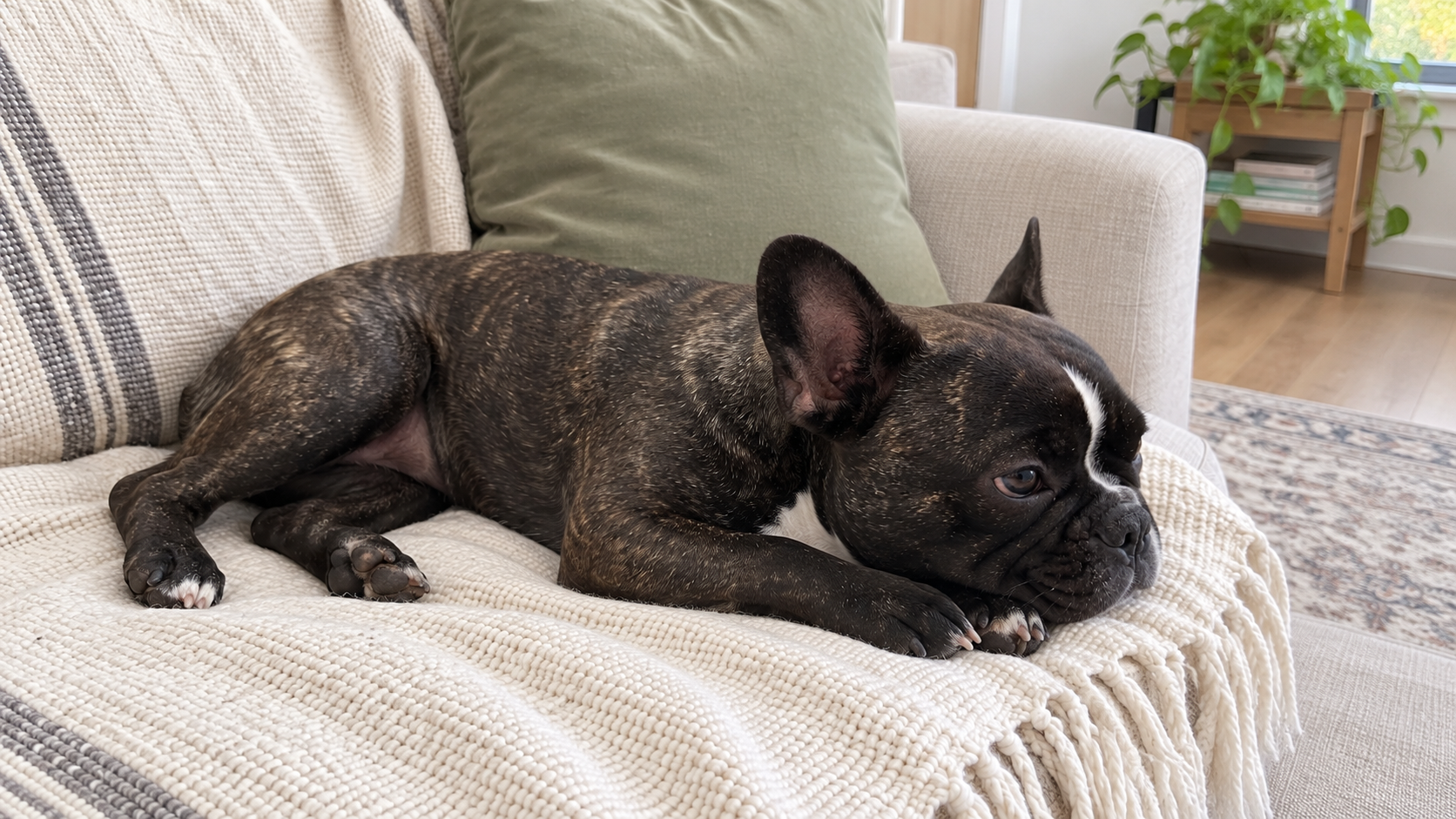

A Frenchie parent from our dog park, the one with the little fawn boy who screams with joy at his own shadow, told me last August that she had stopped walking him between 10 a.m. and 7 p.m. entirely. Not shortened the walks. Cancelled them. At the time I thought it was a bit much. Then I watched my own dog pant herself into a wobble on what I would have called a perfectly reasonable warm morning, and I understood: with this breed, summer is not a season, it is a logistics problem.
That wobbliness was a warning sign, not an ordinary part of a summer walk. Flat-faced dogs are at increased risk of heat-related illness. Here is how I plan warm-weather days around Nina, alongside our Frenchie exercise guide. Adjust the season to your local weather rather than a fixed set of months.
Key takeaways
- Plan outings around actual heat, humidity and your Frenchie’s comfort, not the clock alone.
- Provide a cool resting space and drinking water; cooling gear cannot make a hot walk safe.
- Suspected heatstroke needs immediate cooling and urgent veterinary contact. Start cooling before transport and continue safely on the way.
Why French Bulldogs are vulnerable to summer heat
Panting is important for cooling, and flat-faced airway anatomy can make it less effective. Risk also depends on health, activity and the surroundings. There is no single outdoor temperature that guarantees safety for every Frenchie.
Nina will happily choose a sunny spot, so I do not assume she will always move herself before getting too warm. I watch her comfort and change the environment. Persistent breathing noise or effort deserves veterinary assessment, not acceptance as a breed quirk.
Nina’s summer routine
Walks move to the edges of the day. From late spring onward, we have used early mornings or after sunset, but those times can still be too hot. I check the actual conditions before deciding to go. Midday outings are for emergencies only, and even then it is a quick shade-to-shade potty trip. Hot pavement is another reason to stay off it. A hand test does not establish that the air temperature or the walk is safe.
The house stays genuinely cool. A fan alone may not provide a sufficiently cool room during a heat wave; arrange access to a genuinely cooler space. On the hottest days Nina has a designated cool corner: tile floor, a fan, and access to water. I do not wrap her in wet towels. A comfortable resting surface is different from emergency treatment; our cooling-mat comparison looks at resting surfaces and their limits.
Water everywhere, always. A bowl in every room she uses, a bottle and collapsible bowl on every outing. I make drinking water easy to reach without forcing her to drink.
Cooling gear has limits. A soaked evaporative cooling vest is optional equipment. I would not count on it to prevent heatstroke or use it to justify an otherwise unsafe outing. Fit, conditions and the individual dog still matter.
Activity adjusts to the conditions. Frenchies still need their outlets in summer; the breed’s modest exercise needs do not disappear with the heat, they just move indoors. On a comfortable indoor day, a puzzle feeder or short training game can provide an outlet. Rest is appropriate when it is too warm; do not provoke running just to meet a daily target.
The car rule is absolute. Never leave a Frenchie in a parked car, not with the windows cracked, not for two minutes, not in spring. A car cabin becomes an oven faster than most people believe, and flat-faced dogs can be especially vulnerable.
Overheating signs and what to do immediately
Unusual heavy panting, noisy or difficult breathing, marked drooling, weakness, vomiting, disorientation or collapse can signal heat-related illness. Do not wait for every sign or for a supposedly safe temperature to be exceeded.
The RSPCA’s heatstroke guidance recommends starting cooling promptly before transport. Move out of the heat, call a vet and apply available water that is cooler than the dog over the body, avoiding the head. Add airflow and arrange cooled, ventilated transport while following veterinary advice. Do not delay to find an ideal water temperature or wait to see whether the dog recovers without help.
Do not force water into the mouth or immerse an unconscious dog. A dog that seems better still needs veterinary assessment after suspected heatstroke. Our health guide covers other concerns, but it is not a substitute for emergency help.
FAQs about keeping French Bulldogs cool in summer
What temperature is too hot for a French Bulldog?
There is no universal safe cutoff. Humidity, sunlight, activity, airway health and the individual all matter. If conditions are uncomfortable, choose a cooler environment rather than relying on a number.
Can French Bulldogs be outside in summer?
Sometimes, depending on the dog and conditions. Keep outings brief and comfortable, with shade and water available, and stop if breathing or behavior changes. Morning and evening are not automatically safe.
Do cooling mats work for French Bulldogs?
They can provide a resting option, depending on the product and room conditions. They do not treat heatstroke or make a hot environment safe. Follow the product instructions and check for damage.
Should I shave my Frenchie for summer?
Do not shave the coat as a heat-management shortcut. Ask your vet about any skin or coat concern; changing the environment and activity is more useful than assuming a haircut resolves airway-related risk.
Why does my Frenchie overheat quickly?
Flat-faced anatomy can affect cooling through panting. Individual airway disease, other health factors and activity can add risk. Discuss limited exercise tolerance or persistent noisy breathing with your vet.
What should I do if my Frenchie has heatstroke?
Start cooling immediately, contact a vet and arrange urgent transport as described above. Do not postpone care because the dog starts looking better.
How can I keep a Frenchie cool at night without air conditioning?
Choose the coolest available space, provide water and monitor comfort. If the home stays too hot, arrange another cooled location. A fan or mat is not a guarantee that the room is safe.