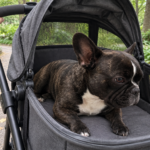
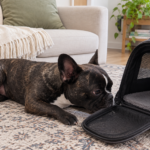
Nina used to ride shotgun like a tiny, unbuckled co-pilot, paws on the dash, zero concept of physics. It took one hard brake at a yellow light, and the sound of 24 lbs of Frenchie sliding into the footwell, for me to grow up about car safety. An unsecured dog is a danger to itself and everyone in the car, and for a breed with a delicate back and neck, a sudden stop is exactly the kind of thing you want to engineer out.
Key takeaways
- K&H Bucket Booster leads this comfort comparison; a booster is not proof of crash protection.
- Check the exact restraint’s fit and installation.
- Do not add an extension tether to a crash-tested harness. Use its specified setup in the back seat.
After that ride with Nina, I separated the decisions: her walking harness, her car restraint and a comfortable place to settle are not automatically interchangeable.
What to check before choosing a French Bulldog car seat
Usable space. Measure your dog sitting and lying down, then compare the seat’s interior and the exact size limit. Restraint evidence. Check how the complete system was tested and how it must attach to the vehicle. Comfort and cleaning. An elevated bed and a washable cover can be useful, but neither proves crash protection or cures motion sickness. The Center for Pet Safety advises against extension tethers, including add-ons used with crash-tested harnesses. I would not buy a booster on the assumption that its included tether makes it a crash-protective system.
Quick scan: the short version
- Foam booster to compare: K&H Bucket Booster
- Rear-facing seat with manufacturer test claims: PupSaver
- Collapsible rear-seat option: Kurgo Skybox Rear Seat Booster
- Best plush comfort: Snoozer Lookout I
The seats, and who each suits
K&H Bucket Booster
K&H’s collapsible Bucket Booster has foam sides and a removable, washable fleece cover. The Large lists an 18-by-13-inch inside cushion; the Small is 12.5 by 13 inches, so the usable floor matters more than the outer dimensions. It includes harness tethers, which should not be treated as evidence of crash protection. This is a comfort comparison, not a recommendation to combine those tethers with a separately tested restraint.
Best for: comparing a washable foam booster’s comfort and space. The Large is around $100 on the manufacturer’s listing; the price varies with the version and color.
PupSaver
PupSaver uses a rear-facing design and publishes manufacturer-sponsored crash-testing claims. That is different from independent certification of every version on sale. Before choosing one, match the exact seat, harness, weight range and installation to the published test documentation. A rear-facing shape alone is not enough to call it the safest option.
Best for: owners comparing a rear-facing system who will check the exact current model and its test evidence before buying. Compare the complete seat-and-harness cost, not an old headline price for a different version.
Kurgo Skybox Rear Seat Booster
The Skybox Rear Seat Booster is the rear-seat model: Kurgo lists a 30-pound limit and an interior 15.5 inches wide, 12.5 inches deep and 8.5 inches high. It folds for storage and can serve as a travel bed at your destination. Its integrated tether and seatbelt attachment are product features, not proof that the complete setup provides crash protection. An elevated view may appeal to a dog, but it does not reliably treat nausea or travel anxiety.
Best for: comparing a collapsible rear-seat bed, provided its interior fits your dog. About $95 for this model.
Snoozer Lookout I
The Lookout I is the plush option, with an elevated, bed-like shape. Check the specific size’s usable interior, weight guidance and cover material rather than treating every Lookout version as the same seat. Nina would pick this one for the nap potential alone. That is the appeal I am describing here; a soft bed and a window view do not establish crash performance.
Best for: comparing a cushioned place to settle. Size and fabric affect the price, so match those options before comparing it with another seat.
The part people skip: the harness
Choose the vehicle restraint as a complete system. Follow its belt routing, fit limits and installation instructions exactly; do not improvise with a booster tether or clip a restraint to the dog’s collar. A walking harness is not automatically a vehicle harness. The CPS-certified product directory is a useful starting point for comparing tested harnesses, carriers and crates, with the exact size and setup still to check.
For short-nosed dogs there’s a second reason to get this right: the American Kennel Club notes French Bulldogs are sensitive to heat, so never leave one in a parked car, and keep your dog secured and follow Frenchie heat precautions.
FAQs about French Bulldog car seats
Do French Bulldogs need a car seat?
A French Bulldog needs an appropriate restraint for car travel, but that does not have to be a booster seat. An unrestrained dog can distract the driver or be thrown in a sudden stop. Compare a suitable vehicle harness, carrier or crate as well as seats; comfort and crash protection are separate questions.
What’s the safest car seat for a French Bulldog?
There is no universal safest seat for every Frenchie and vehicle. Look for credible test or certification evidence for the exact product, then check fit and installation. A booster with an included tether is not equivalent to a certified restraint system.
How do I secure a French Bulldog in the car?
Use an appropriately fitted vehicle restraint in the back seat, following its specified installation. Do not add an extension tether, substitute a walking harness or attach it to a neck collar. Keep the dog away from front-seat airbags and off the driver’s lap.
Why does my Frenchie get car sick?
Motion sickness and anxiety can both make car travel difficult. A better view is not a guaranteed fix. Build up calm, short journeys and keep the vehicle comfortable. If your dog drools, vomits or remains distressed, ask your vet about motion sickness and travel anxiety rather than buying another seat to solve it.
Can I just use a harness and seatbelt instead?
A suitable crash-tested vehicle harness can be an option when it fits your dog and is installed exactly as specified. Some use direct seatbelt routing; do not assume an extension tether belongs in the setup. A booster is not a necessary extra and may change how a restraint works.
Where should the car seat go?
Always the back seat. Front-seat airbags can seriously injure a small dog, so a Frenchie belongs in back, secured, every ride.
Is a dog booster seat crash-tested?
Some manufacturers publish tests for particular systems, but “booster seat” itself says nothing about crash performance. Look for the exact model, dog weight, restraint components and test results. Do not transfer a claim from one model to another.