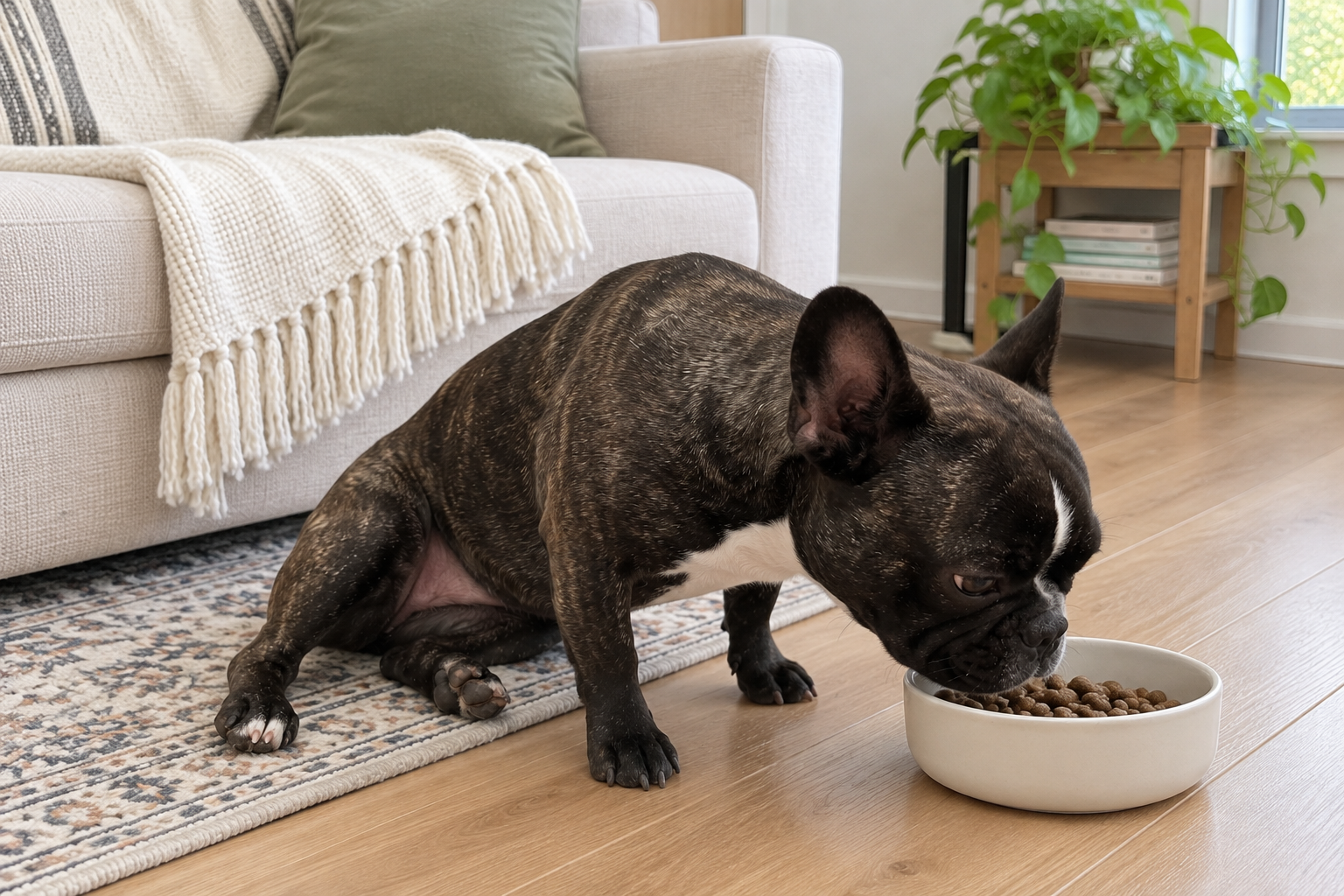

Let me set the scene. It’s movie night, Nina is curled against my leg looking like the most innocent creature ever bred, and then the room turns on us. No warning. No remorse. If you share a couch with a Frenchie, you already know our breed treats flatulence as a personality trait.
Occasional gas happens, but persistent trouble deserves a closer look at the whole diet, portions and eating habits. These foods offer different ways to approach that conversation; none can promise a silent movie night.
Key takeaways
- Royal Canin French Bulldog Adult leads this comparison for adult breed-specific feeding, without a promise to stop gas.
- Change food gradually and keep portions consistent.
- Check treats and eating speed too; persistent gas with other symptoms needs veterinary attention.
Why Frenchies are so gassy in the first place
Swallowed air and fermentation in the gut can both contribute. The food’s overall digestibility and the amount fed matter; an ingredient list alone does not show how a dog will digest it. Our guide to why French Bulldogs fart covers the broader causes.
You can’t reshape Nina’s face, but you can pick food that’s gentle on the gut and slow down how fast she eats it.
How I chose for a gassy Frenchie
Start with a complete diet for the right life stage. Then compare digestibility, calorie density, portion size and your dog’s response. Salmon is not automatically gentler than chicken, and a short ingredient list does not prove a food is better. If allergy or gastrointestinal disease is suspected, let your vet guide the choice rather than cycling through bags.
Quick scan: the short version
- Best overall: Royal Canin French Bulldog Adult
- Small-breed sensitive formula: Purina Pro Plan Sensitive Skin & Stomach (Salmon & Rice)
- Sensitive stomach and skin option: Hill’s Science Diet Sensitive Stomach & Skin
- Best limited-ingredient: Natural Balance L.I.D. Salmon & Sweet Potato
- Alternative protein: Jiminy’s insect-protein recipes
- Best fresh option: The Farmer’s Dog
The foods, and who each may suit
Royal Canin French Bulldog Adult
Royal Canin French Bulldog Adult is formulated for French Bulldogs from 12 months old, with nutrients aimed at digestive health and stool quality. Its kibble shape is designed for the breed’s jaw, but that is not proof that it prevents swallowed air. Check the ingredient list if your dog has a diagnosed food allergy.
Best for: an adult Frenchie whose diet suits this formula. Compare the 6-, 17- and 30-pound bags by price per pound; the formula is not a treatment for a diagnosed allergy.
Purina Pro Plan Sensitive Skin & Stomach (Salmon & Rice)
Salmon is the first ingredient in the linked Small Breed recipe, which includes rice and natural prebiotic fiber. The current formula should not be described as having “live probiotics baked in.” When Nina’s been gassy on something richer, this has been my reset button. That is her response, not a guarantee for another dog.
Best for: comparing a small-breed adult sensitive formula. The linked recipe comes in 4- and 16-pound bags, rather than the 30-pound size of a different recipe.
Hill’s Science Diet Sensitive Stomach & Skin
The linked Hill’s product is Small & Mini Chicken, with prebiotic fiber, vitamin E and omega-6 fatty acids. It is a sensitive-stomach food, not a diagnostic allergy diet. Do not assume a salmon-labelled version is interchangeable or free of every ingredient your dog needs to avoid.
Best for: an adult dog suited to this chicken-based Small & Mini recipe. Compare the exact bag size and formula when checking prices.
Natural Balance L.I.D. Salmon & Sweet Potato
Natural Balance’s salmon-and-sweet-potato recipe limits the animal protein sources, which can simplify everyday feeding. It does not establish why a dog has gas, and fewer ingredients do not necessarily mean less fermentation. A diagnostic food-allergy diet trial needs your vet’s choice of diet and strict rules about treats and other foods.
Best for: comparing a limited-ingredient maintenance food when its ingredients suit your dog. It should not be presented as a substitute for a veterinary elimination diet.
Jiminy’s insect-protein recipes
Cricket is a different protein source, but “novel” means new to the individual dog. The linked Cravin’ Cricket recipe also contains oats, quinoa, sweet potato, brown rice, chickpeas and peas. Insect protein does not make the whole recipe allergy-proof or guarantee less gas. The texture and smell may take some getting used to.
Best for: considering an alternative-protein complete food with your vet when it fits your dog’s history. Match the recipe and bag size before comparing prices.
The Farmer’s Dog
The Farmer’s Dog is a cooked-food subscription with meal portions based on the information you provide about your dog. You still need to account for treats, check body condition and adjust feeding when appropriate. Cooked fresh food is not automatically more digestible for every dog than a suitable kibble; refrigerated storage and the ongoing cost also matter.
Best for: owners who prefer a cooked subscription and can manage its storage and cost. Persistent gas on several diets is a reason for assessment, not simply another subscription.
Food won’t fix everything (here’s the rest)
If Nina inhales dinner in nine seconds, I look at eating speed as well as the bag. A suitable slow feeder for a flat face may help, and smaller meals can be worth discussing with the vet. That isn’t just folk wisdom: veterinary gastroenterologists note that smaller portions improve digestibility and leave less residue to ferment, which is almost word-for-word what my vet said when I asked why Nina’s worst nights followed her biggest meals.
A probiotic may be useful in some situations, but effects depend on the strain and the problem. Our French Bulldog probiotic comparison explains those differences. If loose stools accompany the gas, use the sensitive-stomach food guide alongside your vet’s advice rather than expecting one recipe to settle every symptom.
One caution: gas that comes on suddenly, or arrives with vomiting, bloating, or a hard belly, is a vet matter, not a food experiment, because a tight, bloated belly can signal a real emergency. It also helps to know that swallowed air drives a big share of dog gas, which is exactly why slowing a Frenchie down matters as much as changing the food.
FAQs about food for gassy French Bulldogs
Why is my French Bulldog so gassy?
Swallowed air, diet and gut fermentation can contribute, and illness can also cause excessive gas. Eating quickly is one thing to check, but ongoing flatulence should not simply be blamed on a Frenchie’s face.
What food reduces gas in French Bulldogs?
A complete food your dog digests well may help. Royal Canin French Bulldog Adult and the sensitive formulas above are options to discuss, but no protein name or “low filler” claim guarantees improvement. Review portions and extras as well as the main food.
Can changing food too fast cause more gas?
An abrupt switch can upset digestion. Introduce the new food gradually according to the maker’s directions or your vet’s plan; a sensitive dog may need longer. Do not wait out vomiting, pain or a swollen abdomen as a normal transition.
Do probiotics help with dog gas?
Some products may help particular digestive problems, but “probiotic” does not tell you the strain, dose or evidence. Ask your vet whether one is appropriate; it should not delay finding the cause of persistent symptoms.
Should I avoid grain-free food for a gassy Frenchie?
Grain-free is not a treatment for gas, and grains are not automatically the problem. Compare the complete formula and your dog’s needs rather than choosing by that label alone. Discuss any medically necessary restrictions with your vet.
Could a slow feeder really make a difference?
It may help a dog who gulps meals, provided the bowl is accessible to a flat muzzle and does not cause frustration. It cannot guarantee less gas or treat gastrointestinal disease.
What can I give my French Bulldog for gas?
Review the regular food, treats, portions and eating speed with your vet. Avoid adding human gas medicine or several supplements on your own. Sudden severe discomfort, repeated unproductive retching or a swollen abdomen needs urgent veterinary care.
Why do my Frenchie’s farts smell so bad?
Some compounds produced during gut fermentation have a strong smell. The smell alone does not identify an allergy or a specific ingredient. Track food changes and accompanying symptoms, and seek advice if it becomes persistent or markedly different.