

Key takeaways
- Choose the activity for the individual dog. Skip fabric and cardboard if your dog chews or swallows them.
- Start with visible, easy-to-reach food; frustration is not the goal.
- Use part of the normal meal and keep other pets separate.
- Stay actively involved, stop at damage or chewing, and put everything away afterward.
A homemade dog toy does not need to be an elaborate craft. A simple food-search game can give your Frenchie something interesting to do without turning socks, bottles or knotted string into chew toys. The important distinction is between a supervised activity and an object designed to withstand chewing. For Nina, I would choose an easy setup I could watch closely, not a project built around a promise of being indestructible.
For purpose-made options, our French Bulldog toy guide covers different play styles. The ideas here are short, supervised foraging sessions, not homemade “indestructible” toys or substitutes for appropriate puppy teething chews.
Before you make anything
The RSPCA’s enrichment safety guidance emphasizes suitable materials, size, age and play style, with no sharp edges or loose parts. That is more useful than a promise that a particular household object is safe for every dog.
Work in a comfortable, clear space. Inspect the materials before each session. Don’t use stained packaging, staples, tape, exposed glue, loose threads or damaged fabric. These activities need an adult watching the dog, not simply someone elsewhere in the house.
If your dog guards food or objects, don’t test that problem with a new puzzle or reach into their mouth. VCA recommends caution and professional advice around guarding, and separating pets when food toys could cause competition.
1. An easy towel fold
For: a dog who searches for food without grabbing, shredding or swallowing fabric. Skip it: for fabric chewers.
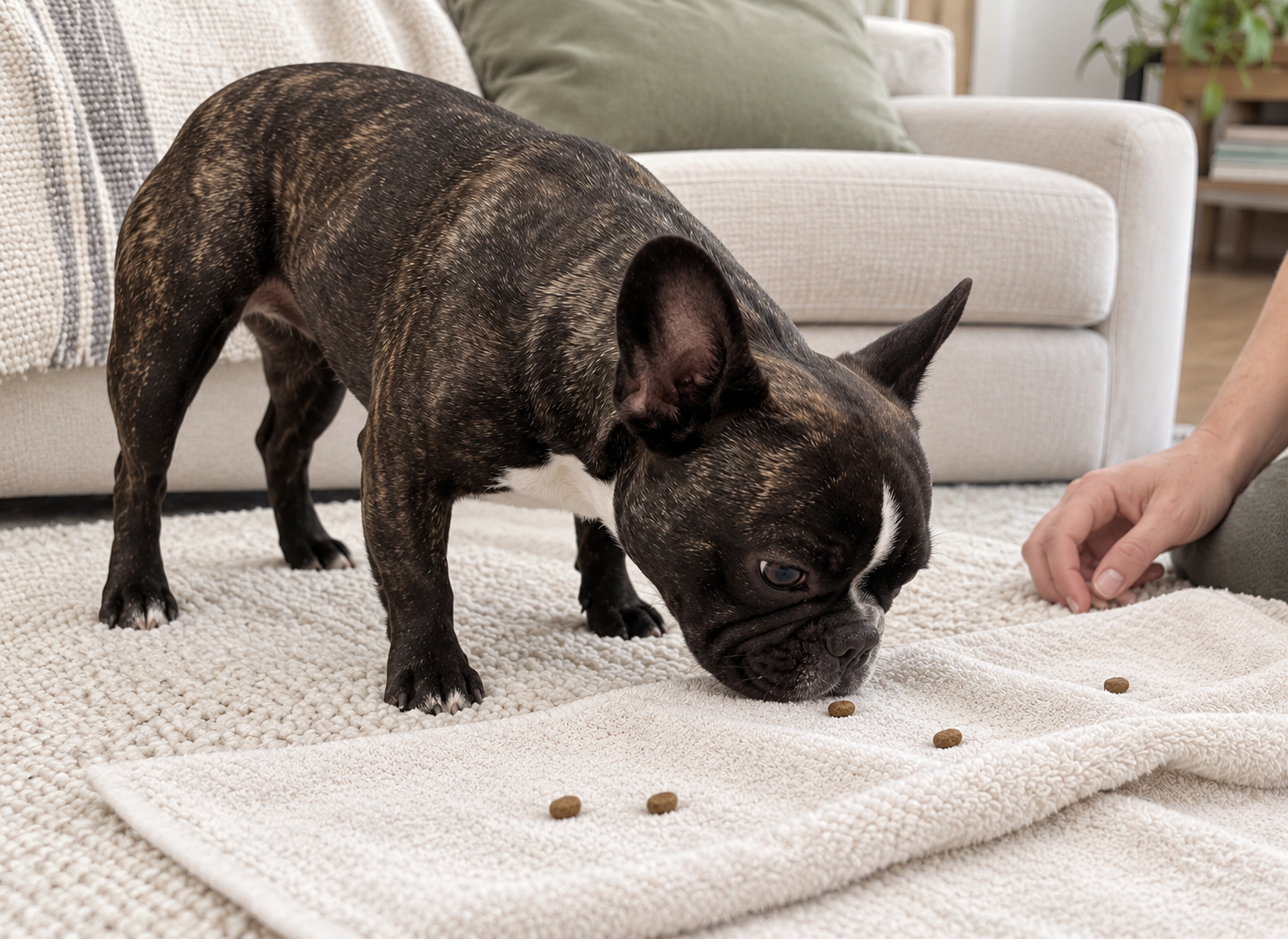
- Choose a clean, intact towel without frayed edges or dangling threads. Lay it flat on a surface where it won’t slide around.
- Put a few pieces of the dog’s usual dry food on top, clearly visible.
- Let your dog find those first. Then hide a little food under one loose fold, leaving the edge easy to lift with the nose.
- Stay beside the activity. End it if your dog starts biting or pulling at the towel rather than searching for food.
- Remove the towel and leftovers when finished; wash and dry the towel before reuse.
This is a gentler starting version of the RSPCA branch’s towel-food activity. There is no need for tight knots, a complicated roll or a challenge your dog has to tear open.
2. A shallow open-box search
For: a dog who can investigate cardboard without eating it. Skip it: if your dog shreds, gulps material or finds boxes worrying.
- Use a clean, plain, shallow cardboard box with an open top. Remove every staple, label and piece of tape. If the box can’t be made clean and simple, don’t use it.
- Choose a low-sided shape your Frenchie can reach into comfortably without squeezing their head through an opening.
- Place a few pieces of the usual food directly on the bottom. Leave them visible for the first attempt.
- Let your dog approach voluntarily. Don’t close the lid, add packing filler or hold their head inside.
- Finish before the cardboard becomes a chewing project. Collect the box afterward and discard it if damaged, damp or soiled.
The ASPCA includes box puzzles in its DIY enrichment ideas and stresses active supervision. This open version deliberately leaves out nested boxes and wrapping. More layers are not automatically better enrichment.
3. A no-material “find it” game
If fabric and cardboard are a poor match, you can leave out the homemade object entirely.
- Choose a small, clear area of clean floor with good footing.
- While your dog watches, place a few pieces of their normal food in easy, reachable spots.
- Let them sniff and collect the food at their own pace.
- As they understand the game, vary the locations slightly without hiding food inside furniture, near cables or in places that require climbing.
AAHA suggests starting indoor scavenger hunts with easy hiding places. Keep the food accounted for within the daily ration, and finish while the dog is comfortable and interested. A short successful game is enough.
What about homemade puppy teething toys?
Searching for a cheap chewing solution is understandable, but household materials don’t become safe because a puppy is small. These foraging activities do not provide a tested teething chew.
VCA advises avoiding extremely hard puppy chews and choosing appropriate items with some give. Supervise chewing and remove a toy that is breaking apart. Ask your vet about a suitable size and material instead of making a chew from sticks, hard plastic or bundled fabric.
The same boundary applies to strong adult chewers. No DIY design here is described as indestructible. If your dog tries to eat every homemade material, use the no-material search or an individually suitable purpose-made option.
When to stop and when to call the vet
Stop if the dog becomes frustrated, starts destroying materials or seems uncomfortable. Don’t keep increasing difficulty to make an activity last longer. For a Frenchie, labored breathing is a reason to end play and seek veterinary advice, not something to push through.
If you think material has been swallowed, contact your vet promptly. Animal Trust’s obstruction guidance warns about vomiting, abdominal pain, reduced appetite and lethargy, but you don’t need to wait for those signs after a suspected ingestion. Never pull string protruding from the mouth or back passage.
FAQs about DIY dog toys
Can I leave a homemade puzzle with my dog while I go out?
Not these activities. Put the towel or box away when active supervision ends. Successfully using it once does not prove it is safe unattended.
Does a more difficult puzzle provide more benefit?
Not necessarily. Make success easy at first, watch the dog’s response and simplify if they lose interest or become frustrated. You are offering a choice, not setting an exam.
Do I need special treats?
No. If suitable for your dog, a portion of the normal meal is a practical starting point. Keep any dietary restrictions in place, including during an elimination-food trial.
