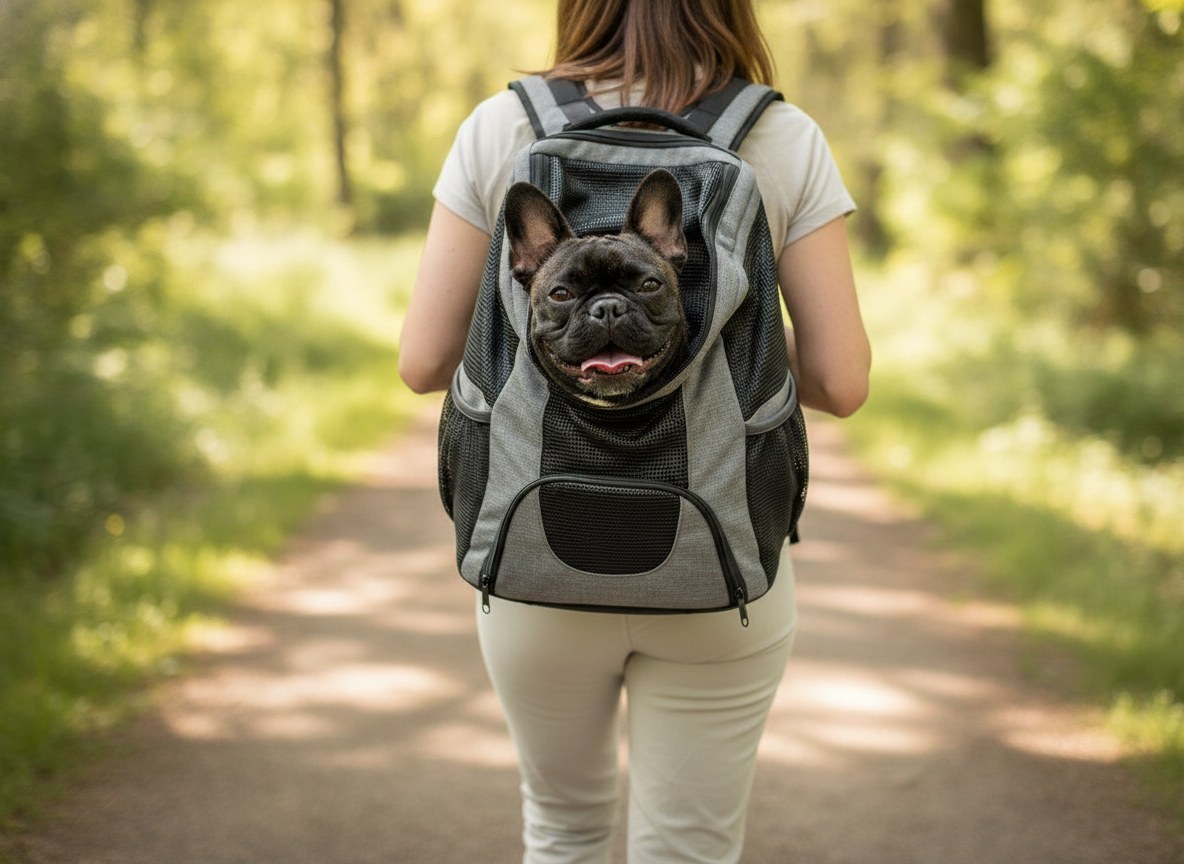

The first time I put Nina in a carrier backpack, she gave me a betrayed look that lasted exactly until we reached the farmers market, at which point she became the smuggest dog in three counties, riding above the crowd like tiny royalty. A good backpack is one of those gear pieces that quietly expands your life with a Frenchie: public transit, crowded markets, long museum days, the steep part of a trail where her short legs and shorter nose tap out.
Key takeaways:
- Ventilation is the whole ballgame. A Frenchie pressed into a stuffy bag overheats fast, so mesh on multiple sides is non-negotiable.
- Match the carrier to your dog’s back length and weight (most Frenchies are 16 to 28 lbs), and favor structured support over a saggy sling for their delicate spine.
- Use a backpack for stretches your dog can’t safely do, heat, crowds, distance, not to skip the daily movement they actually need.
How I chose for a Frenchie
Airflow, airflow, airflow. Multiple mesh panels and openings, because brachycephalic dogs can’t shed heat well and a closed bag becomes an oven. Support for the back. A firm, structured base beats a hammock-style sling that lets a long-backed dog sag. The right fit, sized to back length and weight, snug but not crushing. Comfort for you too, padded straps and a waist belt, since 25 lbs adds up. And real US availability with airline-friendly options for the travelers.
Quick scan: the short version
- Best overall: K9 Sport Sack Air 2
- Best value (great ventilation): PetAmi Deluxe
- Best for hiking: Kurgo G-Train
- Best premium / travel: Roverlund Ready-for-Adventure
The backpacks, and who each suits
K9 Sport Sack Air 2
The category standard, and for good reason. It’s sized by back length so you actually get a proper fit, has a structured base that supports a Frenchie’s spine and tail instead of letting them slump, and uses breathable mesh with collar and harness clips inside. Durable Cordura fabric means it survives real use. Size it carefully and it’s the safest everyday carry here.
Best for: most Frenchies as a do-everything carrier. Around $90 to $120.
PetAmi Deluxe
The value champ that doesn’t skimp where it counts. Ventilated mesh on multiple sides, sherpa bedding inside, plus a waist and chest buckle and padded back so the load sits comfortably on you. It’s rated to about 18 lbs, so it suits smaller Frenchies, check your dog’s weight before buying.
Best for: smaller Frenchies and budget-minded owners who still want real airflow. Often $40 to $60.
Kurgo G-Train
The rugged, trail-ready choice. It’s built for dogs up to 25 lbs, has a roll-away mesh top for airflow, a waterproof bottom, and enough structure and storage to double as a daypack. This is the one I’d grab for the parts of a hike where Nina’s nose and legs say “I’m done.”
Best for: hikers and commuters who want a tougher, more technical pack. Around $80 to $100.
Roverlund Ready-for-Adventure
The polished, airline-compliant option. Three zippered head openings and three-sided ventilation keep a Frenchie cool, and the thoughtful extras (a laptop sleeve, water-bottle holders, an inner leash clip) make it a genuine travel bag, not just a dog box. Rated for pets up to about 25 lbs.
Best for: frequent travelers who want one bag that looks good and flies. Roughly $150 to $180.
Carrying a Frenchie safely
Two honest cautions. First, heat: never zip a Frenchie into a closed compartment on a warm day, keep the mesh open, stay in shade, and watch for heavy panting. Second, their backs: a Frenchie’s long spine is prone to disc problems, so a structured, supportive base matters more than for most breeds, and you should ease them in and out rather than letting them twist. A backpack is for the stretches your dog can’t safely manage on foot; the rest of the time, what keeps a Frenchie healthy is gentle, cool-hours daily walking, not being carried everywhere.
And a real one to sit with: experts generally caution against flying brachycephalic breeds in cargo because of their breathing, so an in-cabin carrier (where airlines and the dog’s size allow it) is the safer travel path for a Frenchie.
FAQ: backpacks for French Bulldogs
Are dog backpacks safe for French Bulldogs?
Yes, when they fit right and ventilate well. The risks for this breed are overheating and back strain, so choose a structured, well-ventilated carrier sized to your dog, keep the mesh open, and avoid the heat. Used that way, a backpack is a safe, useful tool.
What size backpack does a French Bulldog need?
Size by back length and weight, not guesswork. Most adult Frenchies are 16 to 28 lbs, and carriers like the K9 Sport Sack are sized by measuring your dog’s back. Confirm your dog’s weight against the carrier’s limit, some value packs top out around 18 lbs.
Is a backpack or a sling better for a Frenchie?
A structured backpack is usually better for the breed. Frenchies have long, injury-prone backs, and a firm, supportive base protects the spine far better than a saggy sling. Slings are fine for very short carries, but a backpack wins for real distance.
What’s the proper way to carry a French Bulldog in a backpack?
Support their bottom and back as you place them in, secure the internal harness clip, keep the ventilation open, and snug the waist and chest straps so the weight sits on your hips and shoulders. Take them out the same careful way, no twisting.
Can I fly with my French Bulldog in a backpack carrier?
Sometimes, if the airline allows in-cabin pets and the carrier fits under the seat. Flying brachycephalic dogs in cargo is risky because of their breathing, so in-cabin is the safer route, always check the airline’s specific carrier and breed rules first.
How long can a Frenchie stay in a backpack?
Keep it to shorter stretches and take breaks. Let them out to walk, stretch, drink, and cool down regularly. A backpack is for getting through heat, crowds, or tough terrain, not for keeping a dog packed away for hours.