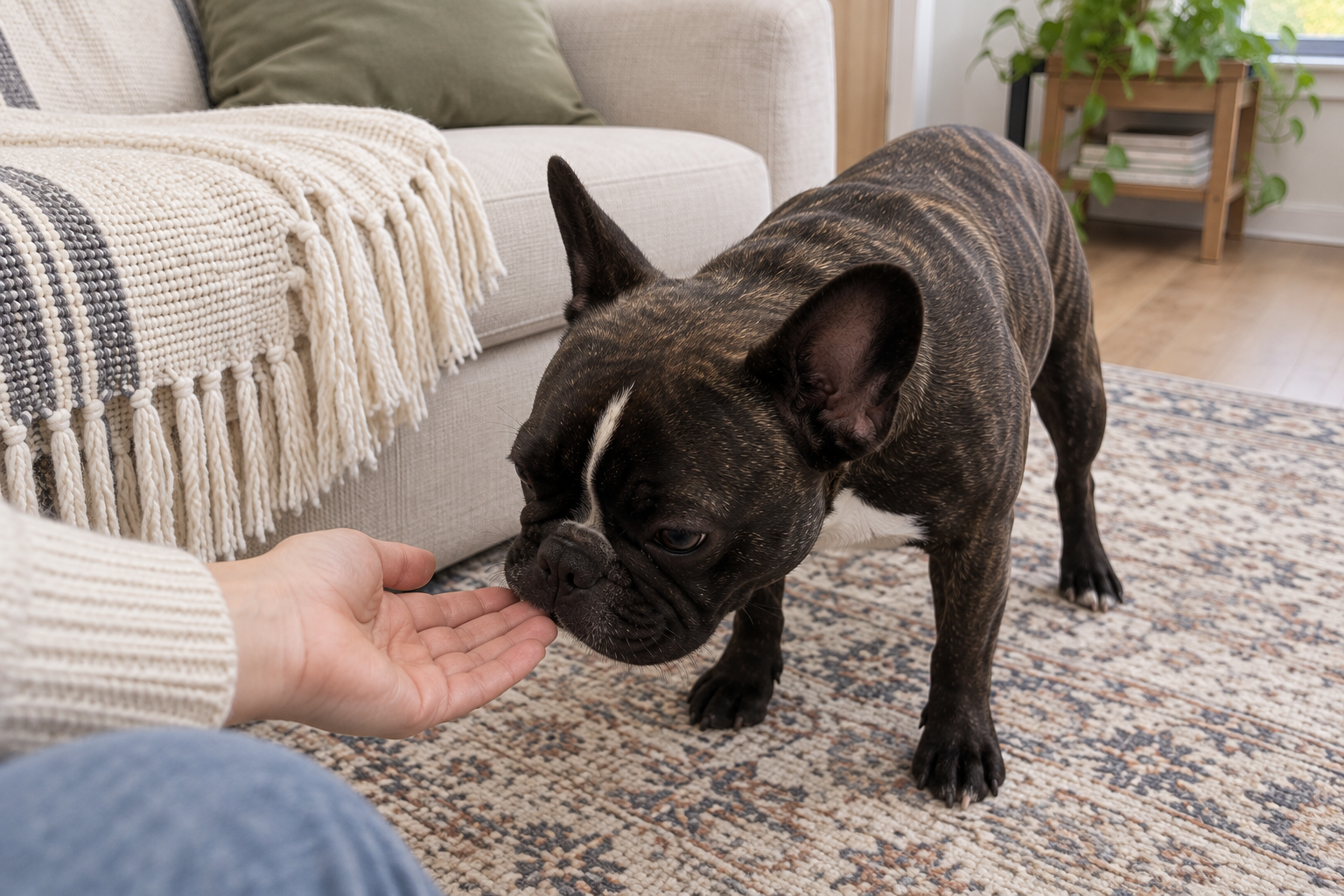

At Nina’s last checkup, the vet did the tactful pause and said she was “carrying a little insulation.” Nina, for the record, was thrilled with herself. She’d spent the winter perfecting a stare that converts directly into snacks, and three humans in this house had been falling for it independently.
Frenchies gain weight the way the rest of us accumulate browser tabs, gradually and then suddenly. Here’s how I finally admitted she was heavier than she should be, why extra pounds are genuinely dangerous in this breed, and the unglamorous plan that worked.
Key takeaways
- Check ribs, waist and weight trend with your vet; a breed-standard number is not a diagnosis.
- Set an individual food, treat and activity plan before cutting portions.
- Keep everyone using the same daily allowance, and review progress on the schedule your vet recommends.
How to tell if your French Bulldog is overweight
Frenchies are stocky by design, which gives every chunky Frenchie a built-in alibi. So skip the mirror and do three checks. Run your palms along the ribcage with light pressure: you should feel ribs under a thin cushion, like the back of your hand. If you have to press to find them, that’s padding. Look down from directly above: behind the ribs there should be a visible waist tuck, not a straight line from shoulders to hips, and definitely not an outward bulge. From the side, the belly should slope up from chest to hind legs rather than hanging level.
Numbers help as a trend line, not a verdict. The show standard’s 28-pound cutoff is not a medical boundary. A French Bulldog weight chart can provide context, but body condition, muscle and build matter. Use the same scale where possible and agree on a monitoring schedule with your vet.
Why extra weight matters for a Frenchie
Excess body fat can add to health and mobility concerns. In a flat-faced dog, breathing and heat tolerance deserve particular attention. The VetCompass French Bulldog study describes breed health risks; it does not mean every overweight Frenchie has the same airway condition.
When I asked our vet what single change would add healthy years to Nina’s life, she didn’t mention supplements or fancy food. She said “keep her lean.” That was the whole answer. I took it seriously, without treating weight control as a guarantee against every illness or a promise of extra years.
The weight-loss plan that actually worked
Weigh the food. A generously filled measuring cup made it too easy to lose track. A gram scale made our portions more consistent. We fed for her target weight, not her current one, with the vet setting the number, and moving her onto a food chosen for her individual needs meant her portion still looked like a meal instead of a punishment.
Put treats on a budget. We put treats within the overall food plan. As a general rule, AAHA recommends no more than 10 percent of calories from treats. We counted them within daily calories, and each morning that ration goes into a jar and when the jar’s empty, the treat economy is closed for the day. It also ended the three-humans-feeding-independently problem, because everyone draws from the same jar. Green beans and cucumber became her “volume snacks,” and to her evident surprise, she likes them.
Move more, gently. For Nina, short sniffy walks in the cool parts of the day were more manageable than a long slog. Your vet can help adapt activity to your Frenchie’s needs. Do not push through breathing difficulty, heat or pain to burn calories. Food puzzles can use part of the measured meal rather than extra snacks.
When to involve the vet
Before starting the diet. Ask for a body-condition and muscle assessment, an appropriate target, a nutritionally complete feeding plan and a follow-up date. Your vet can also investigate medical contributors where indicated.
AAHA’s clinical weight-management guidance describes roughly 1–2% per week for dogs, but that is not a target to impose on every Frenchie. Puppies, dogs with illness and other individual circumstances need different decisions. If progress is unexpected, contact the clinic rather than making a large cut or waiting for a fixed number of weeks. Watch comfort, appetite and muscle as well as the scale.
FAQs about overweight French Bulldogs
How do I know if my French Bulldog is fat?
Ribs that are difficult to feel, little visible waist and increased weight can suggest excess body fat. Have your vet assess body condition and muscle; appearance or weight alone is not enough.
How much should a French Bulldog weigh?
There is no single healthy weight for every Frenchie. Build, muscle, age and body condition matter. A breed-standard cutoff should not determine a medical weight-loss target.
Is 30 pounds too heavy for a French Bulldog?
Not enough information by itself. It exceeds the show-standard cutoff, but the health question is whether this dog carries excess body fat. Ask for an individual body-condition assessment.
How fast should a French Bulldog lose weight?
Agree on the pace and monitoring with your vet. Roughly 1–2% weekly appears in some dog weight-management guidance, but it is not a universal prescription. Unexpected loss or poor progress needs a plan review.
What exercise is safe for an overweight Frenchie?
Use activity suited to the individual’s breathing, joints and comfort, often short gentle outings in suitable weather. Do not use strenuous exercise or heat exposure to force weight loss.
How do I get my Frenchie to lose weight?
Start with a veterinary assessment and a measured, nutritionally complete food plan. Include treats and extras in one household allowance and arrange follow-up. Avoid crash dieting or large unplanned portion cuts.