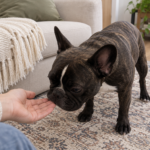
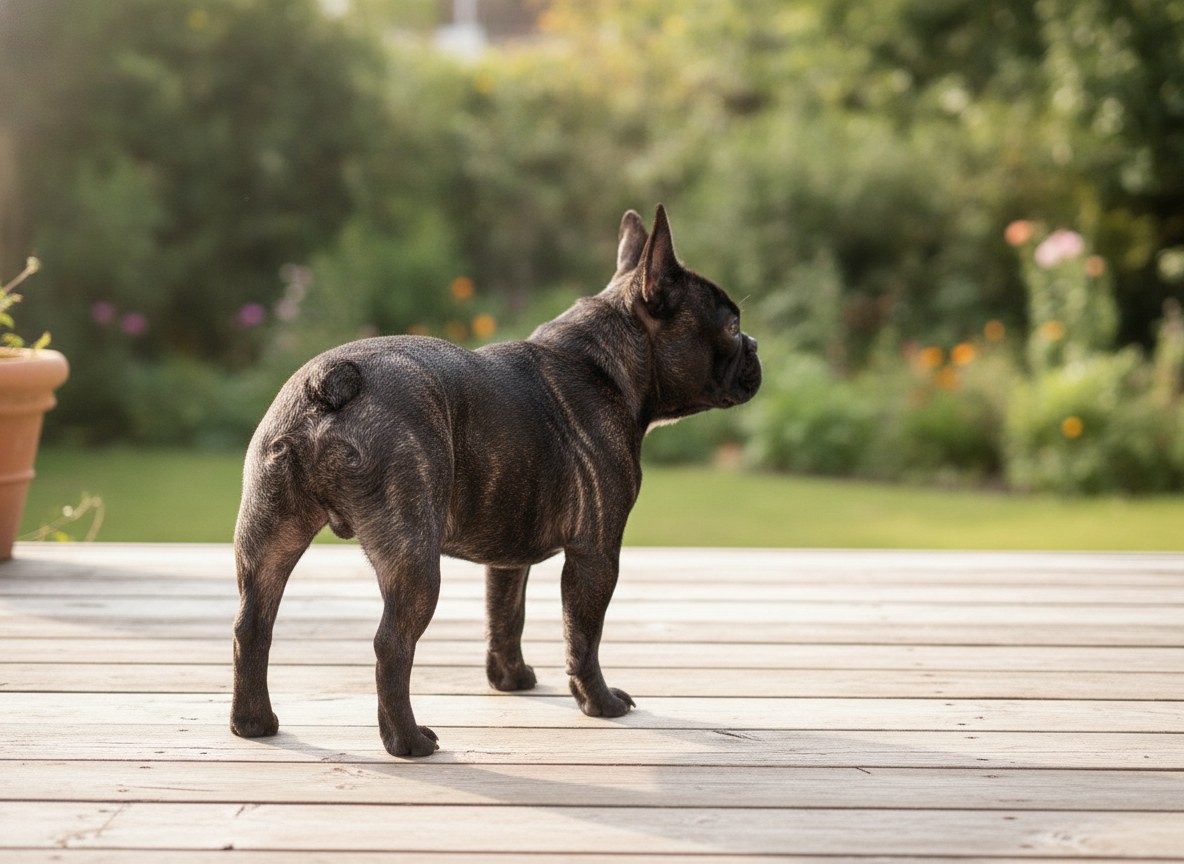

The question I get most on walks isn’t about Nina’s bat ears or the snoring you can hear from the sidewalk. It’s “what happened to her tail?” Nothing happened. That little nub above her back legs is the whole tail, exactly as she was born with it, and when she’s happy it vibrates like a phone on silent.
People assume someone docked it. They’re always slightly horrified, and always relieved by the real answer. So here’s everything living with a nearly tailless dog has taught me, plus the health stuff the cute photos never mention.
Key takeaways
- Frenchies typically have naturally short tails; the familiar nub is not evidence of docking.
- Check any tail pocket and keep it clean and dry.
- New hind-leg weakness needs prompt veterinary attention. Tail shape alone cannot tell you whether the spine is healthy.
Are French Bulldogs born with short tails?
French Bulldogs typically have naturally short tails, though length and shape vary. The familiar nub does not need to be created by docking. Nina’s has always been part of her; it is small, but very much a tail.
Tail and spinal development have a genetic component, but a visible tail is not a diagnostic test. Our French Bulldog health guide covers the wider concerns to discuss with your vet.
The three tail types
Owners often describe tails as straight, screw-shaped or tightly corkscrewed. These are descriptions of appearance, not three medical grades. Some tails sit close against the rump; others have a more visible taper.
The French Bulldog breed standard describes a short tail that may be straight or screwed, but not curly. A show standard is not a health assessment: neither a tight nub nor a longer tail establishes the condition of the rest of the spine.
How a dog with no tail says hello
A Frenchie can’t wag much, so the wag relocates. Nina greets people with a full-body wiggle that starts at the shoulders and ends with her entire rear end swinging like a metronome. The nub itself vibrates when she’s truly delighted. You learn to read the rest of the dog instead: a loose body and an invitation to play look different from a stiff, withdrawn dog. Read the whole posture and situation rather than deciding from one ear or tail movement. Frenchies are so expressive with their faces, ears, and bodies that after a month you stop noticing the tail is missing from the conversation.
Tail problems worth knowing about
A tail pressed close to the body can create a skin fold that needs attention. Redness, odor, discharge, scooting or pain when the area is touched can signal a problem. They do not identify its cause, and scooting can have other explanations too. Ask your vet rather than repeatedly scrubbing a sore fold.
UC Davis research links a DVL2 variant with the screw-tail appearance and vertebral changes in related breeds. That does not mean every Frenchie with a screw tail develops neurological signs. A dog’s visible tail cannot tell you whether an abnormal vertebra is affecting the spinal cord.
New hind-leg weakness, wobbliness or difficulty walking needs prompt veterinary assessment. Call immediately if the dog cannot stand or walk, has severe pain or is worsening rapidly. Do not wait until later in the week or assume the tail pocket is the explanation.
For recurrent or severe tail-fold disease, a vet may discuss surgery after assessing the individual dog. This is treatment for a medical problem, not routine cosmetic docking.
Keeping the tail area clean
Not every Frenchie has a tail pocket. I went looking on Nina with the enthusiasm of someone checking a lottery ticket, and she has a shallow one. If you are unsure what you are looking at, have your vet show you; there is no need to probe or force the tail upward.
Check the area regularly. Clean gently with a suitable cloth or vet-recommended product, then dry it carefully. The same clean-and-dry principle applies to bath day and fold care, but your dog’s anatomy and skin history determine the routine.
A weekly sniff alone is not enough to assess a deep fold. Look for irritation and discomfort, and seek advice for a new smell, discharge or soreness. Avoid putting creams or strong cleaners into the pocket without guidance.
FAQs about French Bulldog tails
Are French Bulldogs born with tails?
Yes. A Frenchie’s tail is usually naturally short, with variation in shape and length. A tiny nub is still a tail.
Do French Bulldogs get their tails docked?
The typical short Frenchie tail is natural and does not require docking. Surgery may occasionally be recommended for a medical problem; that is different from routinely shortening a puppy’s tail for appearance.
Do French Bulldogs wag their tails?
They can move the short tail to varying degrees. With Nina, I notice the little movement alongside her whole-body wiggle. Look at the dog’s overall posture and the situation, not just the tail.
Why don’t French Bulldogs have long tails?
The breed has been selected for a short tail, and genetic research has identified a variant associated with screw tails and vertebral changes. That association does not predict symptoms in an individual dog.
Is it rare for a Frenchie to have a long tail?
A longer tail is less typical of the breed’s familiar appearance, but length varies. It does not by itself prove a healthier spine, poorer breeding or a different ancestry.
Do all French Bulldogs have a tail pocket?
No. The depth of any fold varies, and some dogs have no obvious pocket. Ask your vet to show you how to check and care for the area without causing discomfort.
Why does my French Bulldog’s tail pocket smell?
Moisture, debris or inflamed skin may be involved, but smell alone does not identify an infection. Seek veterinary advice if odor persists or there is redness, discharge or pain. Avoid trying stronger and stronger cleaners.