If your dog ate chocolate, call your veterinarian or an emergency veterinary clinic now, even if your dog seems fine. Do not wait for symptoms or try to make your dog vomit on your own.
If your dog is having a seizure, struggling to breathe, collapsing or unconscious, go directly to an emergency veterinary clinic. If possible, have someone call ahead while you travel.
Who to call
Start with your vet or the nearest emergency veterinary hospital. In the United States, the following animal poison services are available around the clock:
- ASPCA Animal Poison Control: 888-426-4435
- Pet Poison Helpline: 855-764-7661
These services charge a fee. The FDA lists both poison centers and emergency veterinary care as options. Outside the United States, contact a local emergency veterinarian or your country’s animal poison service.
What to do while getting help
- Prevent another bite. Move the chocolate and packaging out of reach, and check whether another pet may also have eaten some.
- Keep the evidence. Save the wrapper, ingredient list and any remaining product. A photograph of the label is useful if someone else is taking the dog to the clinic.
- Give the clearest estimate you can. Tell the veterinary team your dog’s weight, the chocolate type, roughly how much is missing and when it may have been eaten. Say if the quantity or timing is unknown.
- Follow the veterinary team’s instructions. Do not give food, milk, oil, medication or a home remedy to “cancel out” the chocolate.
The ASPCA’s poisoning response guidance emphasizes contacting a professional even when a pet appears normal. Delayed symptoms do not make waiting a safer choice.
Quick takeaways
- Call promptly after suspected chocolate ingestion; looking well does not rule out a problem.
- Keep the wrapper and report the amount, time and your dog’s weight.
- Let a veterinary professional assess the risk. Do not induce vomiting or use a home remedy yourself.
Why chocolate is dangerous for dogs
Chocolate contains theobromine and caffeine. Dogs do not process these substances as efficiently as people do, and exposure can affect the heart and nervous system. The risk depends on the product, the amount swallowed and the dog’s body weight.
UC Davis’ veterinary guidance on chocolate poisoning explains that cocoa powder, baking chocolate and dark chocolate generally contain more of these compounds than milk chocolate. “Only one piece” is not a useful safety rule when pieces and products vary so much.
A French Bulldog needs the same prompt assessment as any other dog. Give the clinic your Frenchie’s actual weight rather than using a breed-average number or comparing them with a larger dog who once ate chocolate without an obvious problem.
Does the type of chocolate change the response?
- Cocoa powder and baking chocolate: concentrated forms that need urgent professional assessment.
- Dark or semisweet chocolate: risk varies with the product and cocoa content. Keep the packaging.
- Milk chocolate: lower concentration does not mean harmless. Quantity and body weight still matter.
- White chocolate: much lower in the chocolate-related toxic compounds, but that does not make the whole product appropriate for dogs. Tell the vet about the amount and other ingredients.
- Brownies, cookies, truffles and mixed candy: report the whole recipe or ingredient list, not just “chocolate.” Other ingredients may change the assessment.
The ASPCA’s food-safety guidance identifies chocolate, xylitol, raisins and macadamia nuts among foods that can harm pets. If a candy or baked item contains more than one concerning ingredient, mention all of them. Also tell the clinic if wrappers or other packaging are missing.
What symptoms might you see?
Possible signs include vomiting, diarrhea, unusual restlessness, panting, excessive thirst or urination, a racing or abnormal heartbeat, tremors and seizures. These signs are not a checklist you need to complete before calling.
Cornell’s chocolate toxicity guidance recommends contacting an emergency veterinarian immediately after ingestion. The outcome depends in part on how quickly appropriate care begins, as well as the exposure itself.
Why not use an online calculator or make the dog vomit?
A calculator cannot confirm what was in an unknown brownie, how much a dog swallowed or whether another ingredient matters. An uncertain estimate should be explained to the veterinary team, not rounded down until the result looks reassuring.
Making a dog vomit is not automatically the right response to a poisoning. Cornell’s poisoning first-aid advice directs owners to veterinary assessment before attempting this. Do not use salt, hydrogen peroxide or other vomiting remedies without direct professional instructions. Do not give activated charcoal on your own.
If your dog has already vomited, tell the clinic. It does not prove that all the chocolate is gone or that no further care is needed.
What happens at the veterinary clinic?
The team will assess the exposure and your dog’s condition. Depending on the case, veterinary care may include treatment to limit absorption, fluids, monitoring or medication for specific complications. There is no single at-home treatment that fits every exposure.
If the team recommends observation at home, ask what to watch for, when to call back and where to go if your regular clinic closes. Keep any poison-service case number so the clinic can coordinate advice.
Preventing the next chocolate incident
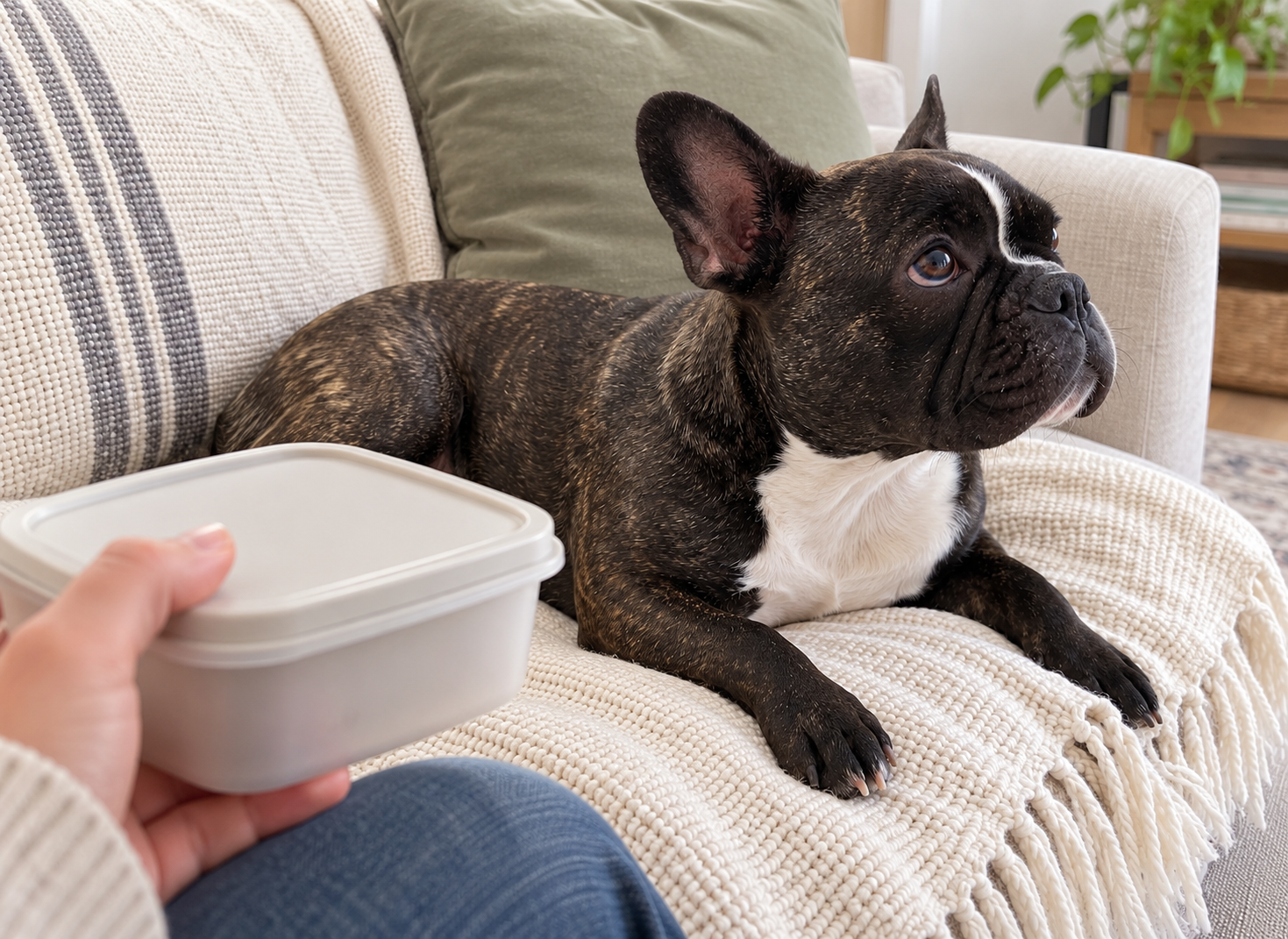
Put candy bowls, baking chocolate and gift boxes in a closed storage space your dog cannot access. Include handbags, children’s treat bags and the rubbish bin in that check. Tell visitors where human sweets belong rather than assuming a coffee table is high enough.
When you want a separate snack for a healthy dog, choose a dog-appropriate recipe such as our dog-friendly waffles, without chocolate additions. That is an option for another day, not something to feed during a suspected poisoning.
FAQs about dogs eating chocolate
Can dogs eat chocolate at all?
Do not offer chocolate as a treat. Some accidental exposures may be assessed as lower risk, but that judgment depends on the specific dog and product.
My dog ate a little chocolate and seems fine. Should I still call?
Yes. Call with the amount, type, timing and your dog’s weight. Looking normal now does not rule out later effects.
What if I do not know how much chocolate my dog ate?
Tell the clinic the amount is uncertain. Save the package and describe how much was available and how much remains. Do not delay the call while trying to reconstruct an exact number.
Should I give my dog milk or pumpkin?
No food is a substitute for veterinary assessment after chocolate ingestion. Ask the veterinary team before giving your dog anything.