Key takeaways
- Compare several signals with your own dog’s usual posture, rather than labeling one facial expression.
- Turning away, tension or attempts to leave are good reasons to pause an interaction.
- A “smile,” wag or belly-up pose is not automatic permission to touch.
- New behavior changes deserve a vet check; breathing difficulty needs medical attention, not an emotional explanation.
A Frenchie’s face can look wonderfully expressive, but an open mouth is not proof of happiness, and a still dog is not necessarily comfortable. Read the whole dog, what is happening around them, and what changes when the situation changes. You are looking for clues that help you respond kindly, not a translation of every ear movement. With Nina, I would pay more attention to a change in her whole posture than to a face that looks funny in a photo.
If you are already seeing growling, snapping or guarding, start with our French Bulldog aggression and safer-next-steps guide. This article focuses on everyday observation before an interaction becomes difficult.
Start with the situation, not the ears
Notice what happened immediately before the change. Was someone reaching toward a paw, leaning over the bed, opening food or arriving at the door? Is your dog free to move away? These details are more useful than deciding that a Frenchie has a permanently “guilty” or “jealous” face.
VCA’s veterinary behaviorists explain that canine signals communicate broad emotional states, not a precise human-style message. A dog can also feel conflicting motivations, such as wanting to be near someone while feeling uncomfortable with what is happening nearby.
Think in observations: “She turned her head and stepped back when the brush approached” is something you can act on. “She hates grooming” is a much larger conclusion. Stop, give space, and consider a gentler approach later rather than testing the conclusion by continuing.
Why Frenchie features can make signals harder to read
A French Bulldog’s upright ears, short muzzle, facial folds and short tail do not offer exactly the same visual information as a long-faced dog with a long tail. Dogs Trust notes that body shape can affect communication, including facial movement in short-muzzled dogs and the visibility of tail signals.
Learn what your own dog’s face, ears and body look like during ordinary comfortable moments. Then look for changes from that baseline. Do not wait for a dramatic tail movement that this particular dog may be unable to show, and do not treat naturally upright ears as proof of excitement.
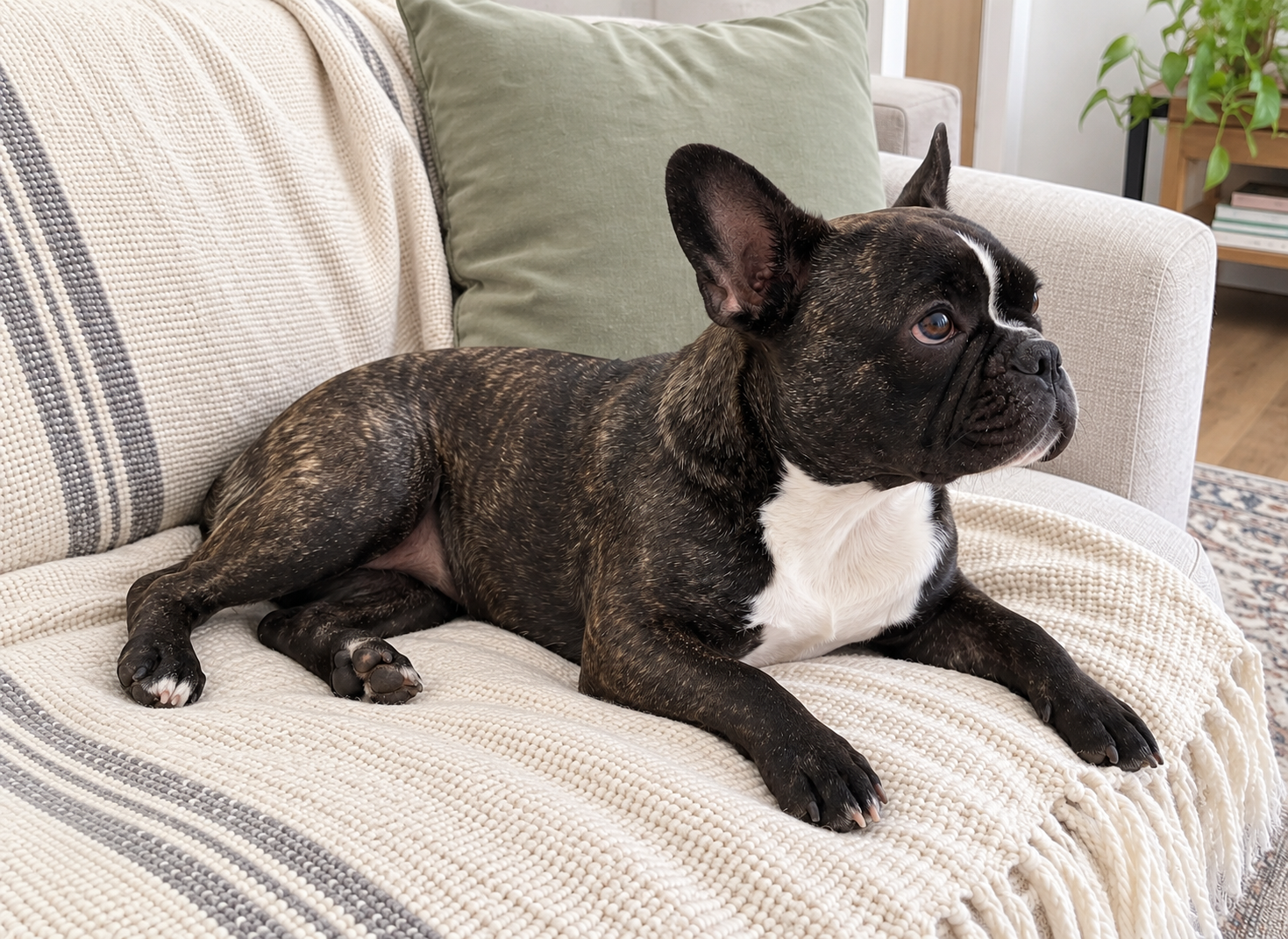
Everyday signals to notice together
Loose posture and voluntary interaction
A softly moving body, an unstrained face and choosing to approach can fit a comfortable interaction. The RSPCA’s body-language guide shows relaxed posture and naturally positioned ears as part of a wider picture, not a single test. Keep watching as the activity changes. A dog who approached you can still want a break after a few moments.
Turning away, lip licking and yawning
These may appear when a dog is uneasy, especially alongside a tense body or attempts to withdraw. They also need context: a yawn is not automatically anxiety, and licking around food does not carry the same information as repeated lip licking while someone leans over the dog.
PDSA’s stress guidance includes turning away, unexpected panting, tension and changes in eye position among signs to consider together. If you see that pattern during handling, pause and let the dog retreat. You do not need to prove exactly which emotion is involved before reducing pressure.
Sudden stillness, stiffness or a fixed stare
Stillness during an interaction is not reliable evidence of acceptance. If your dog becomes rigid as a person or another animal approaches, stop the approach and create space safely. Do not reach closer to see whether a growl follows. VCA cautions that signals can change quickly and that dogs do not all progress through a predictable sequence of warnings.
What a “smile” or belly-up pose cannot tell you
An open mouth can appear in a relaxed dog, but it can also accompany panting. Avoid labeling a photo “happy” without checking activity, temperature, breathing effort and the rest of the body.
Frenchies can have brachycephalic obstructive airway syndrome. Cornell’s BOAS guidance describes breathing difficulty and exercise intolerance among the signs. Severe breathing difficulty, collapse or blue-gray gums needs emergency veterinary help. Do not wait for a supposedly anxious or excited dog to “calm down” when they are struggling to breathe.
Rolling onto the back is not always a request for a belly rub, either. Dogs Trust describes both relaxed invitations and appeasement rolls. If you are unsure, give space rather than reaching in. During an otherwise comfortable greeting, pause your touch and allow the dog to move away; do not hold them in place to finish the cuddle.
Respond without turning observation into a test
- Pause early. Stop the brush, greeting or approach that coincided with tension.
- Leave an exit. Avoid cornering the dog or following them to a resting place.
- Do not provoke a repeat for a video. Notes about an event are useful without recreating it.
- Respect a growl. Create distance safely, rather than scolding or grabbing.
The RSPCA warns that punishing warning signals can suppress them without resolving the underlying concern. Growling or escalating incidents call for a safety plan and qualified help, not a contest over who controls the situation.
When to ask for help
Contact your vet when behavior changes suddenly, touch seems newly uncomfortable, or withdrawal comes with changes in appetite, sleep or normal activity. Pain and illness can influence behavior even without an obvious injury. PDSA recommends veterinary assessment for a sudden change rather than assuming stress alone explains it.
For a useful appointment note, record the setting, what happened just beforehand, the observable movements and what helped the situation settle. Your vet can consider medical causes and advise on appropriate behavior support. Do not wait for a bite before asking.
FAQs about French Bulldog body language
How do I know if my Frenchie is happy?
Look for a pattern of comfortable posture, voluntary interaction and the ability to settle, while considering the situation. A single wag, open mouth or funny photograph cannot confirm happiness.
Does licking mean affection?
Not necessarily. Describe when it happens and what accompanies it instead of assigning a fixed meaning. Licking during a tense interaction is a reason to reassess that interaction, not to insist the dog is enjoying it.
Why does my French Bulldog look sad?
Facial shape is not a diagnosis of sadness. Changes from normal behavior are more informative. A dog who becomes withdrawn, stops eating normally or seems uncomfortable needs assessment rather than a caption about being sulky.
Can I learn body language from photos?
Photos can introduce visible features, but they leave out what happened before and after. Use them as prompts to observe more carefully, not as proof that every dog making a similar face feels the same thing.