
A French Bulldog bath needs a steady footing, a gentle wash and time to dry the places a towel can miss. Start with comfortably lukewarm water and a shampoo made for dogs, keep the spray away from the head, rinse thoroughly, and finish by checking the skin folds.
If you are deciding whether bath day is due, start with how often to bathe a French Bulldog. The steps below focus on the wash itself, rather than setting a calendar for every Frenchie.
Key takeaways
- Use lukewarm water, a nonslip mat and dog shampoo.
- Keep spray off the face. Follow the label and rinse thoroughly.
- Dry folds gently. Ask your vet about sore or smelly skin.
Before you start: check the dog, then the supplies
Look at the skin before reaching for shampoo. Redness, discharge, discomfort or a new smell are reasons to speak to your vet, especially if touching a fold hurts. A routine bath is not a substitute for treating a skin problem.
Set out what you need within reach:
- A nonslip bath mat and a stable place to stand.
- Dog shampoo suitable for your dog’s skin and age.
- A cup or gentle handheld sprayer.
- A soft face cloth and separate clean cloths for other areas.
- Dry towels, with one ready beside the bath.
- Small familiar treats, if your dog can comfortably take them.
For Nina, the treat choice has an extra check: her chicken allergy. I’d use a treat that fits her established diet rather than introduce something new just for bath day. That is a reward choice, not a reason to choose a particular shampoo.
A bottle labeled for dogs is the starting point. Skin disease, a prescribed treatment or a previous reaction can change what is appropriate. VCA’s veterinary grooming guidance recommends dog-formulated shampoo and individual advice when skin problems are involved. Human and baby shampoos are not the routine substitute.
How to bathe a French Bulldog, step by step
1. Make the footing secure
Put the mat in place before the dog gets in. Check the water with your hand and keep it comfortably lukewarm. Arrange the towels where you can reach them without leaving your dog. If you need help moving or steadying your Frenchie, have that help ready before starting.
Keep the pace calm. A slippery tub, sudden spray and a missing towel are three problems worth solving while the dog is still dry.
2. Wet the body gently
Use a cup or a gentle spray to wet the body, keeping the flow below the head. Work gradually over the back, sides, chest and legs. Leave the face for a cloth rather than pouring water over it.
The AKC’s bathing checklist is useful for preparation and thorough rinsing. You do not need to add every optional tool to make the bath work.
3. Follow the bottle, not a homemade dilution rule
Read the directions before applying shampoo. Do not assume every formula should be mixed with water, and do not invent a dilution ratio. Use the amount, application method and contact time specified for that product or by your vet.
Work gently through the body coat with your fingertips. Avoid scrubbing sensitive skin. Keep lather away from the eyes, mouth and ear openings; a body shampoo is not automatically a face-fold cleaner.
4. Keep face and ear care separate
Use a soft, wrung-out cloth for the outer face, away from the eyes and nostrils. Do not aim the sprayer into the ears or push cotton into the ear canals. If your dog needs a particular ear-protection or cleaning routine, have your veterinary team demonstrate it.
Ear odor, pain or discharge is not something to wash out during bath time. Set aside the general bath routine and get advice about the ear itself.
5. Rinse the body thoroughly
Remove the shampoo from each area you washed, including the belly and legs. Work methodically rather than judging the whole dog from the water running off the back. Keep the rinse away from the head.
For prescribed shampoo, contact time matters. VCA’s medicated-bath instructions explain why the treatment should remain on for the prescribed interval before a thorough rinse. Do not shorten that interval, add a second product or change the bath frequency without checking the treatment instructions.
6. Towel-dry, then check the creases
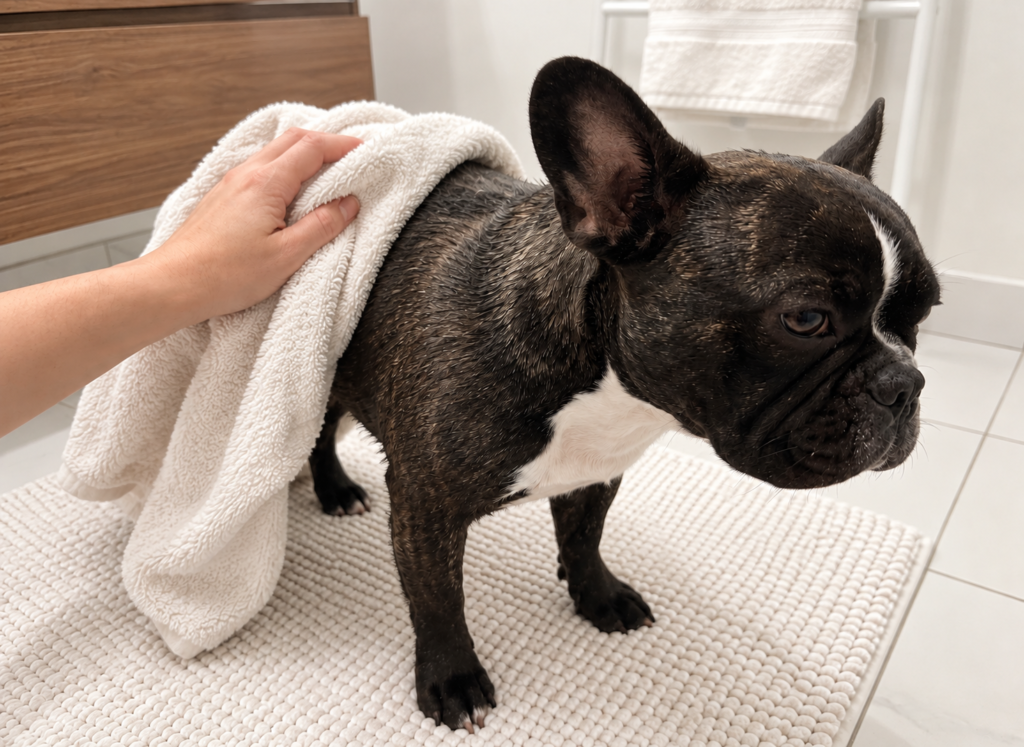
Have a towel ready as soon as the rinse is finished. Dry gently, then give individual folds attention with a clean, soft, dry cloth. Do not rub sore skin or force a cloth into a tight pocket.
Press the towel gently against the coat rather than scrubbing. Keep your dog in a comfortable room afterward and check that the folds are dry. There is no useful fixed drying time: the coat and surroundings affect it.
A short coat may need only towels. If you use a dryer, the AKC recommends a dog-specific dryer, using airflow rather than heat and keeping it away from the face and ears. Introduce its sound and airflow gradually with rewards; stop if your dog is distressed. Ask a groomer for a demonstration if you are unsure.
What about wrinkles and the tail area?
Follow your vet’s advice for cleaning folds, including any accessible fold around the tail. Do not carry the body-shampoo lather into these spaces by default. The appropriate cleaner and routine can differ when skin is inflamed or infected.
PDSA’s guidance on skin-fold dermatitis emphasizes regular cleaning and thorough drying, using products your vet advises. Warm, moist folds can support bacterial and yeast overgrowth. Redness, discharge, smell or pain warrants veterinary attention.
This is a check-and-care step, not a deep-cleaning contest. If you cannot comfortably see or reach the area, ask for a demonstration rather than probing.
Brushing and care between baths
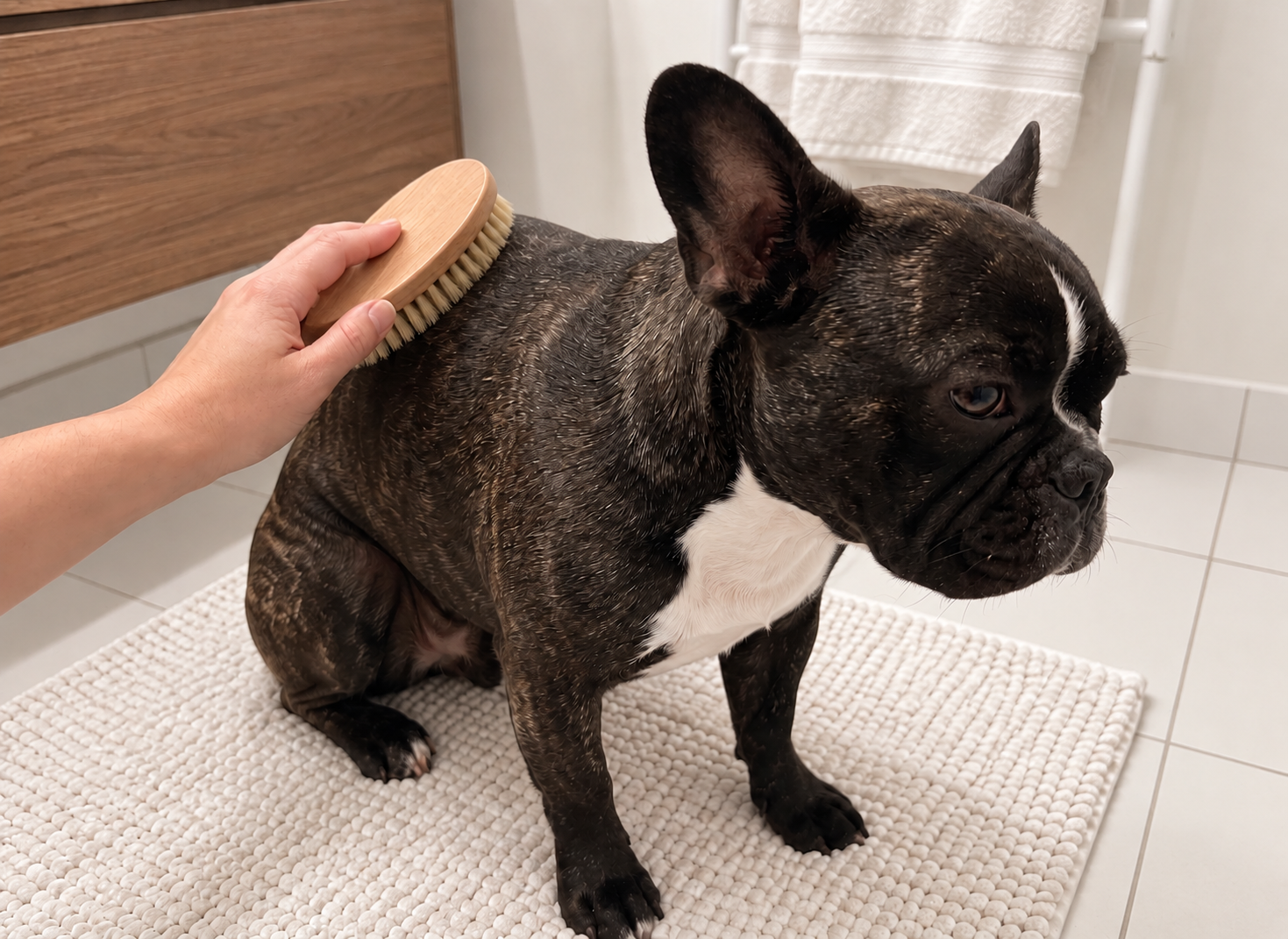
A gentle brush before the bath helps remove loose hair and debris. Choose a tool that suits your dog’s coat and avoid brushing sore skin. For the differences between rubber tools and bristles, see the French Bulldog brush comparison.
Between full washes, check the coat and skin rather than automatically reaching for more shampoo. Keep following the fold-care routine your vet recommends, including drying after cleaning. Regular brushing can be useful, but it does not replace treatment for irritated skin.
Keep separate cloths for the face and rear of the body. For any pocket beneath the tail, ask your vet to show you what can be cleaned comfortably and which product to use. A tight or painful fold is not a place to push harder.
Keep bath day manageable
Decide who will hold the towel, where the shampoo will sit and how your dog will get out before the water starts. If the dog is struggling, stop and reassess instead of trying to finish every step faster.
For a worried dog, practice comfortable handling and towel contact in short, rewarded sessions before bath day. In the shower, keep the footing secure and the spray off the face; do not push through struggling just to finish. Building comfort takes priority over completing a full bath in one session.
Common mistakes to avoid are guessing shampoo dilution, leaving lather behind, aiming spray at ear openings, scrubbing sore folds and rushing drying with heat. Afterward, note what would make the next bath easier: a better-positioned mat, a quieter sprayer or another person to help.
FAQs about bathing a French Bulldog
Should I dilute dog shampoo?
Only when the product directions or your vet tell you to. There is no universal ratio that fits every shampoo.
Can I wash my French Bulldog with Dawn dish soap?
For a routine bath, choose dog-formulated shampoo rather than Dawn or another dishwashing liquid. VCA recommends shampoo made for dogs. If you are unsure what to use for a particular skin problem, ask your vet.
Can I use baby shampoo?
Choose shampoo formulated for dogs. If your Frenchie has a skin condition or has reacted to a product, ask your vet which formula to use.
Does my Frenchie need a blow dryer?
No. Towel-drying and a comfortable place for the coat to finish drying can be enough. Give folds separate attention rather than assuming airflow will dry them.
What if my dog still smells after the bath?
Do not assume the answer is another wash. Check for sore skin or ear symptoms and contact your vet about persistent or recurring odor.
When should a French Bulldog puppy have a first bath?
There is no single birthday or monthly schedule to apply to every puppy. Ask your veterinary team about your puppy’s needs and a suitable product, particularly for a very young, unwell or easily chilled puppy.
Is bathing more often always bad for the skin?
No. Some veterinary treatment plans deliberately include frequent baths. Routine bathing and prescribed skin treatment follow different instructions.