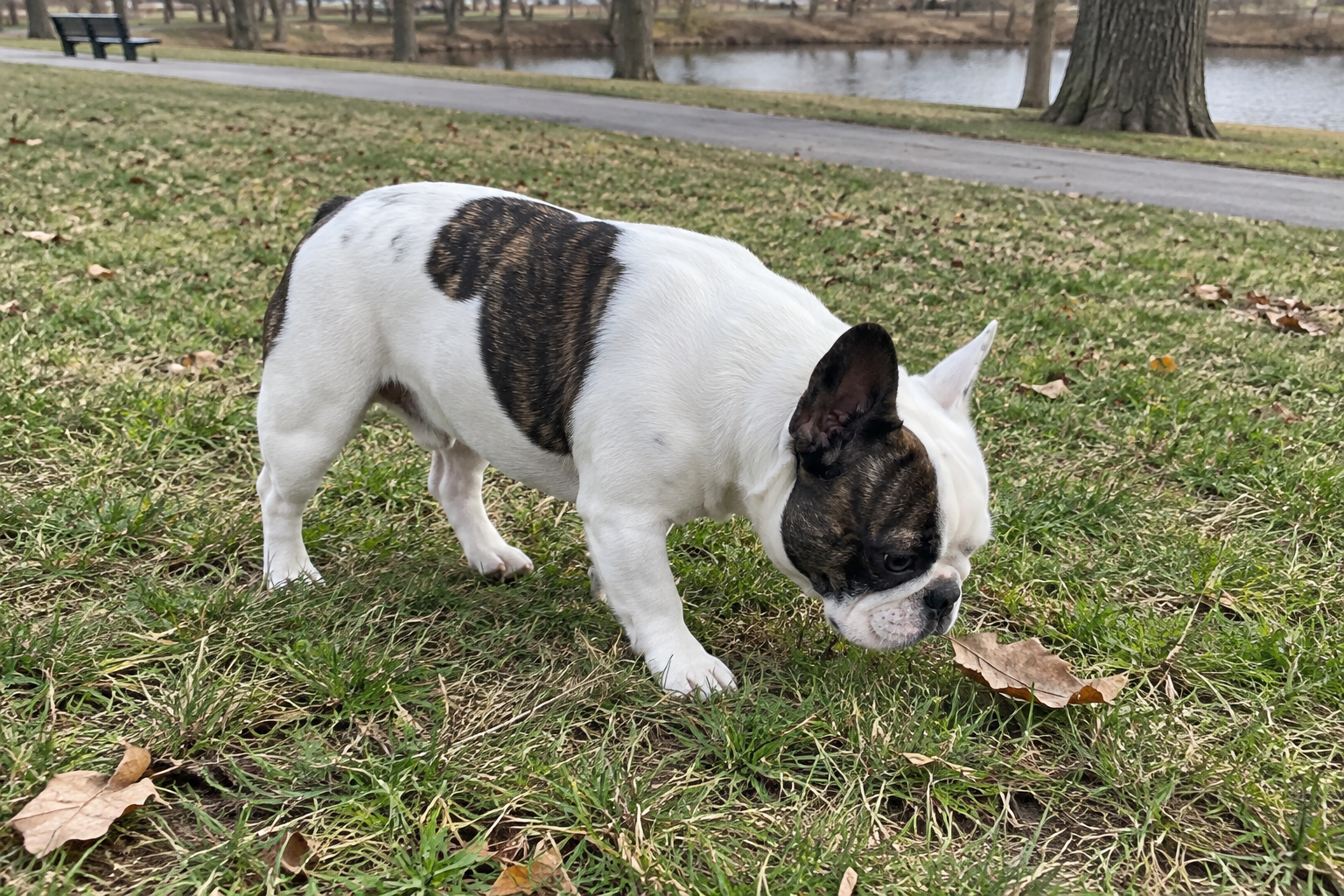

There’s a pied Frenchie at our dog park named Waffle, and at least once a week somebody asks his mom what he’s mixed with. He’s not mixed with anything. He’s a purebred French Bulldog wearing one of the oldest patterns in the breed, mostly white with dark patches scattered around like a very small cow with strong opinions.
Nina adores him, and I’ve stood through enough of those sidewalk conversations to know how much confusion surrounds this pattern. So here’s the plain-English version of what pied actually is, how the genetics work, what to ask about price and hearing, and where the breed standard fits in.
Key takeaways
- Pied describes white spotting with colored patches, not a separate breed.
- Pattern alone cannot tell you a dog’s genetics, hearing or overall health.
- Ask about appropriate hearing screening and health records; do not pay extra simply because a listing calls pied rare.
What a pied French Bulldog actually is
A pied French Bulldog has a coat that’s mostly white with clearly defined patches of another color, usually brindle or fawn, sitting over the eyes, ears, or body. The patches land wherever they please, which is why no two pieds match: some wear a single eye patch like a small pirate, some carry a saddle of color across the back, and some are nearly all white with one rogue spot. Underneath the white, a pied is still a normally colored Frenchie. The piebald pattern just paints white over parts of it, and it’s one entry in a lineup of French Bulldog colors that runs much wider than the fawn-or-brindle most people picture.
You’ll also hear pied called piebald or parti. Same pattern, different vocabulary.
The genetics in plain English
Piebald spotting is associated with a variant in the MITF gene, often discussed as the S locus. It is commonly explained as recessive in French Bulldogs, but the amount and placement of white are not a neat on/off switch. UC Davis notes that white spotting has complex genetics and its expression varies.
Two copies of the tested variant are expected to produce white spotting; one copy may produce little or some white, depending on the breed and individual. “Extreme pied” describes extensive white, not a guarantee that a photograph reveals every gene involved. A test report is more informative than guessing from the size of a patch.
Both brindle and white and fawn and white appear in the official AKC breed standard, which is worth remembering the next time an ad calls pied rare or exotic.
Pied vs merle French Bulldogs
Pied means areas of white beside colored patches. Merle produces a mottled pattern within pigmented areas and involves a different genetic mechanism. A dog can have both patterns, so “pied merle” does not mean an ordinary standard-colored pied.
Merle is not an accepted French Bulldog conformation color, and some merle combinations carry serious hearing and eye risks. Do not infer ancestry or breeding suitability from appearance alone. Likewise, blue or grey coloration describes dilution rather than the distribution of white.
The white coat and hearing question
When I asked our vet why white-headed dogs get flagged for hearing checks, she explained the association between pigmentation and congenital deafness. That does not mean every white or pied dog is deaf, and coat markings cannot tell you whether both ears work normally.
LSU’s veterinary guidance explains that hearing loss in one ear can be easy to miss without a BAER test. Ask your vet or breeder about appropriate screening and request the result for each ear.
A BAER result assesses hearing at the time of testing; it does not guarantee hearing for life. Later illness, injury or aging can affect hearing too. If your dog stops responding as usual, arrange a check rather than relying on an old puppy result.
What a pied should cost
There is no single reliable price for a pied French Bulldog. Compare current local quotes, what health screening has been performed, the written agreement and the care provided. A striking patch pattern does not establish health or justify a premium by itself.
Ask the same questions you would for any French Bulldog breeder: can the records be verified, can you meet the mother and see how the puppies are raised, and what support is offered? A higher price does not answer those questions for you.
Pied French Bulldogs and the breed standard
Pied does not automatically mean show-eligible or show-ineligible. The underlying color and the rest of the dog still matter. The French Bull Dog Club of America’s color explanation discusses brindle pied and pigmentation requirements, including the need for brindle within a pigmented patch when judged as white and brindle.
Use the actual standard for show questions, rather than assuming all white-and-dark dogs qualify. For a companion, patch placement is a personal preference; it does not replace health screening or tell you the dog’s temperament.
FAQs about pied French Bulldogs
Is a pied French Bulldog rare?
Pied is an established pattern in the breed. How common it is varies between breeding lines, but the word rare in an advertisement is not evidence of quality or a reason on its own to pay more.
What is a piebald Frenchie?
Piebald and pied refer to white spotting with colored patches. It is a pattern rather than a separate breed or one specific underlying color. The extent of white can vary considerably.
How much does a pied French Bulldog cost?
Compare current prices and inclusions locally rather than using one universal range. Verifiable health screening, puppy care and the agreement matter more than whether the markings look unusual.
Are pied French Bulldogs deaf?
Pied appearance does not diagnose deafness. White pigmentation is associated with congenital hearing loss in some dogs, and one-sided loss may be hard to notice at home. Ask about BAER testing rather than assuming either normal hearing or deafness.
Can two pied parents have a solid puppy?
If both parents have two copies of the tested piebald variant, each puppy inherits that variant from both. The visible amount of white still varies. Appearance alone is not enough to establish the parents’ genotypes or predict exact markings.
Do pied Frenchies have more health problems than other colors?
Hearing screening deserves discussion, but color is not a full health assessment. Ask about the same breathing, movement, skin and other breed-related checks you would for any Frenchie. A normal hearing result does not rule out unrelated problems.