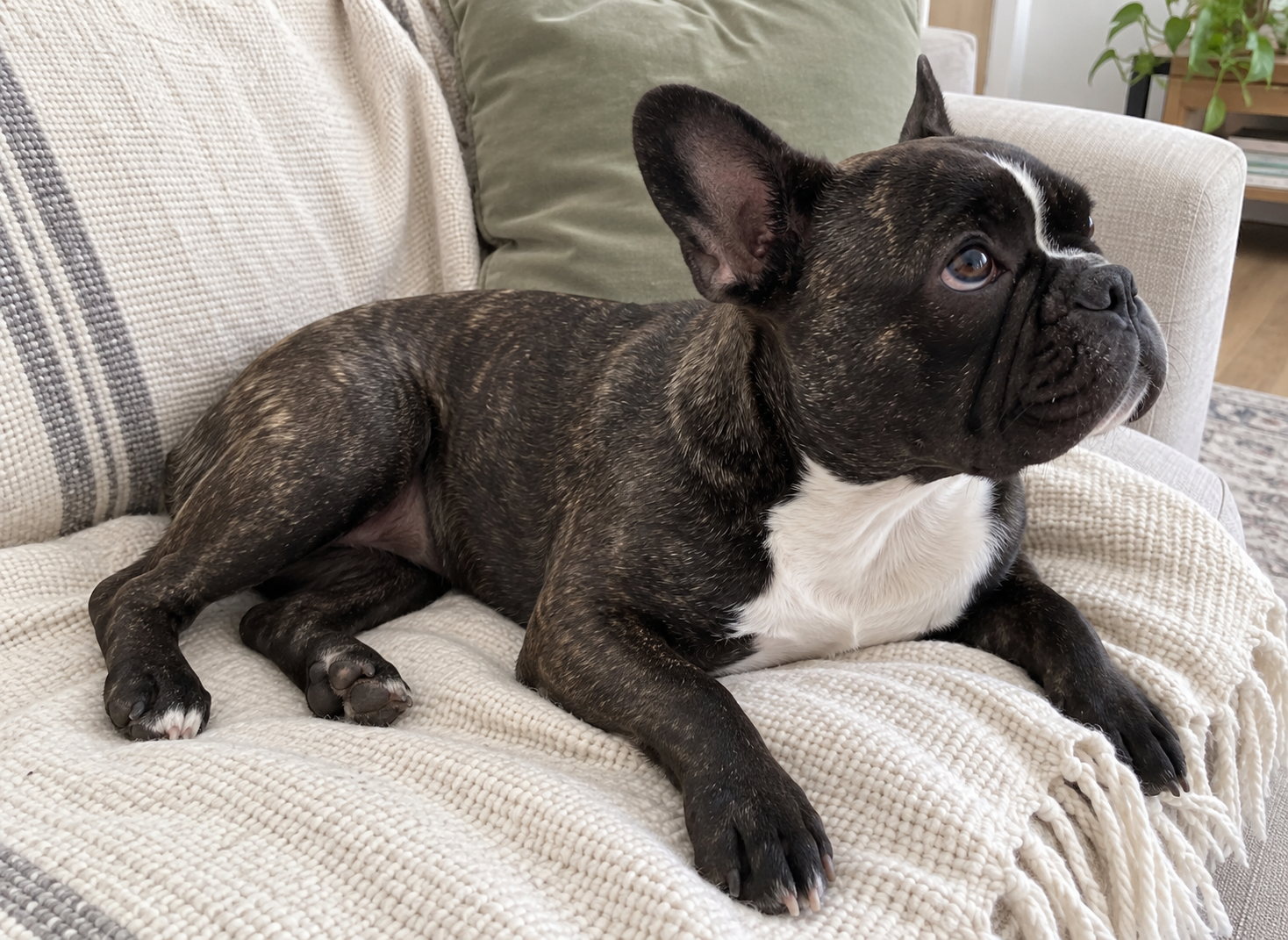

Nina is staring at me as I write this. She has been staring for eleven minutes. She is not blinking much, her head is tilted at the precise angle of maximum pathos, and I know, with the certainty of long experience, exactly what she wants: the crust of the toast I finished four minutes ago. She will maintain this position for as long as it takes. She has nowhere to be.
If your Frenchie does the same, you have wondered whether it is love, need, judgment, or a con. The honest answer, after years of cohabitation and a little actual research: I find four useful ways to read the situation. They are observations, not a diagnosis. The same attention to routines shows up in reward-based Frenchie training.
Key takeaways
- Staring can mean a request, anticipation, comfortable attention or uncertainty; read the whole situation.
- Soft eye contact is different from a hard stare with a tense body. Give the dog space when needed.
- New, fixed or unresponsive staring deserves veterinary advice, especially with other changes.
The four stares, decoded
After enough evenings under surveillance, I have sorted Nina’s staring into four working categories.
The affection stare. Soft eyes, a relaxed face and a comfortable body can accompany friendly attention. A study of dogs gazing at their owners found changes in owners’ urinary oxytocin during social interaction. That is interesting bonding research, not a test proving what every stare means. When Nina looks comfortable, I enjoy the moment; if she turns away, I let her.
The request stare. Intense, unblinking, targeted. The dog wants a specific thing, food, the door, the toy under the couch, and has learned that sustained eye contact followed by a glance at the object is a reliable extraction method. Frenchies are frighteningly good at this; the same social intelligence that makes them excellent negotiators in training makes them elite at wordless demands.
The anticipation stare. You stood up. You touched the leash drawer. You opened a bag of anything. This stare is your dog reading your routine like a weather forecaster, because Frenchies learn household patterns fast and position themselves early for anything that might benefit them.
The concern stare. Different texture entirely: fixed, hard, or glassy, often with a tense body, pinned ears, or pacing. This is the one to read carefully, because it can mean anxiety, pain, or nausea rather than a request.
Why your Frenchie may watch you so closely
Frenchies are companion dogs, but that does not establish that they stare more than other breeds. Nina knows the household routine, and a look that has earned attention or a snack before may be worth trying again. The temperament guide explains the broader people-focused reputation without making it a rule for every dog.
The AKC’s explanation of staring includes watching for cues and trying to communicate. Notice what happens immediately before and after the look. A leash being picked up is a different context from a tense dog guarding a chew.
When staring means something else
Most staring is charming. Some is information. Pay attention when the stare comes with company:
- Staring plus whining, panting, or pacing can accompany an unmet need, anxiety or discomfort. Check water, toilet needs and the situation, but do not dismiss persistent panting or other signs of illness.
- Staring at walls or into space, especially in a senior Frenchie, or staring with a dazed, disconnected quality, deserves veterinary advice, particularly if new or accompanied by disorientation. If the dog is unresponsive, collapses or has seizure-like activity, seek urgent veterinary help.
- A hard, still stare directed at another dog or a stranger, with a stiff body and closed mouth, is not the con artist at work. That is tension, and it is your cue to calmly create distance before it escalates.
- Sudden new staring at you combined with clinginess or appetite changes can be a dog telling you they feel unwell in the only way they have. Behavior changes are worth noticing, even when the dog is normally expressive.
And then there is the most common scenario, which needs no intervention at all: your Frenchie is staring because you are eating, and they believe, correctly, that persistence has a non-zero success rate. In our house the success rate is classified, but Nina clearly believes it justifies the staffing costs. Some evenings the staring escalates into a lap around the living room, the full zoomie performance, which I choose to interpret as enthusiasm rather than protest.
FAQs about French Bulldogs staring at you
Why does my Frenchie stare at me while I eat?
They may be anticipating food, especially if watching has earned a reward before. If you want a different routine, teach and reward a comfortable alternative such as settling nearby rather than punishing the look.
Is it normal for a French Bulldog to stare at their owner constantly?
Watching you can be ordinary communication, but “constant” deserves context. Notice whether the dog is relaxed, responsive and able to settle. New, persistent or distressed behavior deserves advice rather than an automatic breed explanation.
Why does my Frenchie stare at me and whine?
It could be a request, anticipation, anxiety or discomfort. Check ordinary needs and the environment. A new or persistent pattern, especially with appetite, energy or breathing changes, warrants a vet call.
Do dogs stare at you because they love you?
Comfortable eye contact can be part of friendly interaction, but a stare alone does not prove affection. Look at posture, context and whether the dog chooses to remain engaged.
Why does my Frenchie stare at nothing?
They may be attending to something you have not noticed, but repeated fixed staring, disorientation or a new change needs veterinary advice. Unresponsiveness or collapse requires urgent help.
Should I stare back at my Frenchie?
Gentle eye contact is fine if your dog remains comfortable and can turn away. Do not hold them still or stare them down. A hard look with a tense body is a cue to give space, even with your own dog.