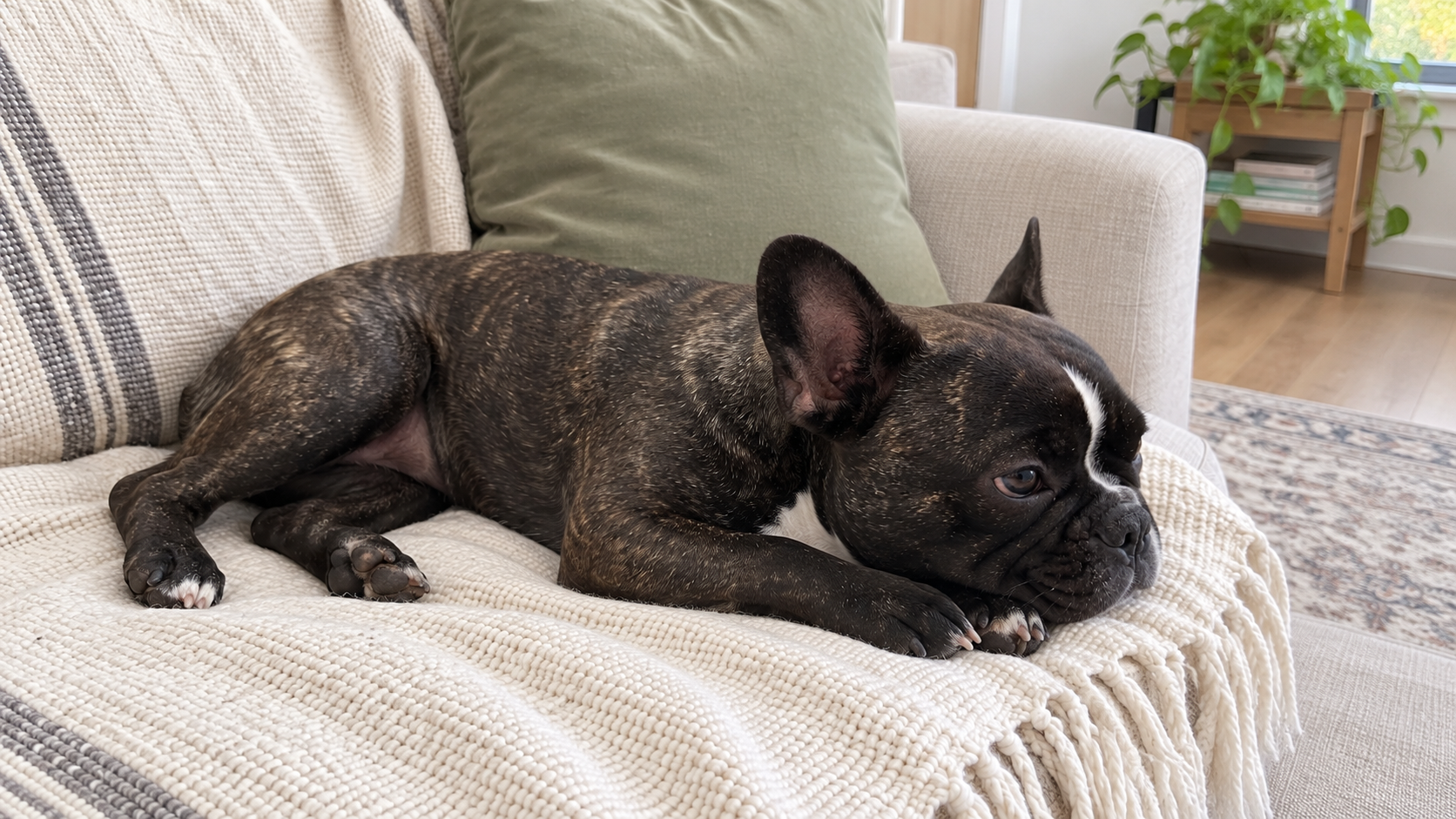

Last spring Nina launched herself off the couch the way she has a thousand times, except this time she landed with a yelp I’d never heard before and stood there shaking. Twenty minutes later we were at the vet, and I got a crash course in a term I wanted to understand immediately: intervertebral disc disease.
We were lucky. Hers turned out to be a muscle strain, not a disc. But the conversation that followed changed how we live. Our Frenchie health guide covers the wider picture; this page focuses on spinal warning signs and what to do next.
Key takeaways
- Sudden neck or back pain needs prompt veterinary advice. Weakness, dragging legs or bladder changes can be an emergency.
- Limit movement while arranging care; do not test pain sensation at home.
- Treatment depends on the examination. Ramps, a harness and sensible weight management cannot guarantee prevention.
What IVDD is in French Bulldogs
Intervertebral disc disease involves the discs between the spinal bones. A disc problem can cause pain and, when the spinal cord is affected, problems with movement or nerve function. A yelp after a jump does not tell you which injury has happened; Nina’s muscle strain is a good reminder of that.
Frenchies are a breed in which disc disease is an important concern. When I asked our vet how worried I should be, she said Frenchies and Dachshunds were the two breeds she saw most often for disc emergencies. That was her clinical experience, not a statistic predicting Nina’s future.
Southeast Veterinary Neurology explains Frenchie disc disease and why other disorders can look similar. A neurologic examination and appropriate imaging may be needed to establish the problem.
Early signs and stages of IVDD
You may see five-stage or five-grade descriptions online. They summarize clinical severity, not a sequence you should wait to watch at home. Grading systems can differ, and pain perception must be assessed by a veterinary professional.
- Pain with walking still possible: a tense posture, crying when lifted or reluctance to move can be warning signs.
- Walking but weak or uncoordinated: stumbling, scuffing or crossing the feet warrants urgent advice.
- Unable to walk independently: severe weakness or dragging limbs needs emergency assessment.
- Paralysis: clinicians also assess whether pain perception remains. Do not pinch toes or assume a reflex movement answers that question.
The American College of Veterinary Surgeons describes the examination, tests and treatment choices. Neck problems can affect different limbs from lower-back problems, so do not rule out a spinal problem because it does not match a rear-leg example.
When it is an emergency
Call your vet promptly for sudden neck or back pain. New wobbling, inability to walk, dragging limbs or difficulty urinating requires urgent assessment. Do not use a 24- or 48-hour number as a safe waiting period or a reason to give up on care after that time.
Prevent running, jumping and stairs while you contact the clinic. Ask how to move and transport the dog with as little unnecessary movement as possible. Do not massage, stretch or repeatedly walk the dog to test improvement, and do not give human pain medication.
IVDD treatment, recovery and costs
Some dogs are managed with prescribed confinement and medication; others need surgery. The decision depends on the diagnosis, pain, nerve function and progression. Rest instructions are specific to the patient, including toileting, handling and rechecks. They are not a home diagnosis or a reason to blame an owner if a case worsens.
Surgery aims to relieve pressure where appropriate. The clinic will explain imaging, anesthesia, hospitalization and aftercare. Ask for an itemized estimate and what it excludes, including rehabilitation or complications. A generic national price cannot predict your bill.
Recovery may take weeks or months and can be incomplete. Ask what changes to record, which signs require an immediate call and when activity may increase. New weakness during recovery needs reassessment; it is not automatically a normal step toward healing.
Our insurance comparison explains policy questions to ask, including exclusions and pre-existing conditions. Do not assume a newly purchased policy covers an episode that has already started.
Everyday changes after our scare
We added a ramp after our scare, and Nina accepted it within a week. Bribery was involved. That helped us change her furniture routine; it is not proof that a ramp prevents IVDD.
- Keep weight appropriate. Discuss body condition and feeding with your vet.
- Use comfortable handling equipment. A well-fitted harness can avoid pressure from a neck lead, but is not a spinal-disease cure.
- Manage access and footing. Reduce avoidable slips and uncontrolled furniture launches with a setup your dog can use safely.
- Follow the individual activity plan. A healthy dog’s routine differs from prescribed recovery restrictions.
Our exercise guide covers ordinary daily activity. If injury is suspected, veterinary instructions take priority over that routine.
FAQs about IVDD in French Bulldogs
Can French Bulldogs recover from IVDD?
Many dogs improve, but outcome depends on the injury and treatment. Ask the treating team about this dog’s prognosis and care needs rather than assuming a general success rate applies.
What are the first signs of IVDD in Frenchies?
Sudden pain, reluctance to move or an altered gait can be warning signs. They are not specific enough to diagnose IVDD at home; contact a vet promptly.
What does stage 1 IVDD mean?
It commonly describes pain without a walking deficit, but grading terminology varies. It still needs veterinary assessment, and an owner should not assign the grade or wait for it to progress.
At what age do Frenchies get IVDD?
It can affect younger adults as well as older dogs. Age alone cannot rule it out, so respond to signs rather than waiting until the dog reaches a particular birthday.
What is the life expectancy of a French Bulldog with IVDD?
There is no single prediction. Severity, complications, comfort and long-term care all matter. Discuss quality of life and prognosis with the team treating the individual dog.
How much does French Bulldog IVDD surgery cost?
Request a local itemized estimate covering diagnosis, imaging, surgery, hospitalization and aftercare. Prices and required treatment vary too much for one figure to be a reliable quote.
Can IVDD be treated without surgery?
Sometimes, under a veterinary plan. Worsening signs, severe pain or loss of function may change the recommendation. Do not choose home rest instead of an examination.
How do I know my Frenchie is healing from IVDD?
Use scheduled rechecks and the observations your vet asks you to record. Looking livelier does not automatically mean restrictions can end; new pain or weakness warrants a call.