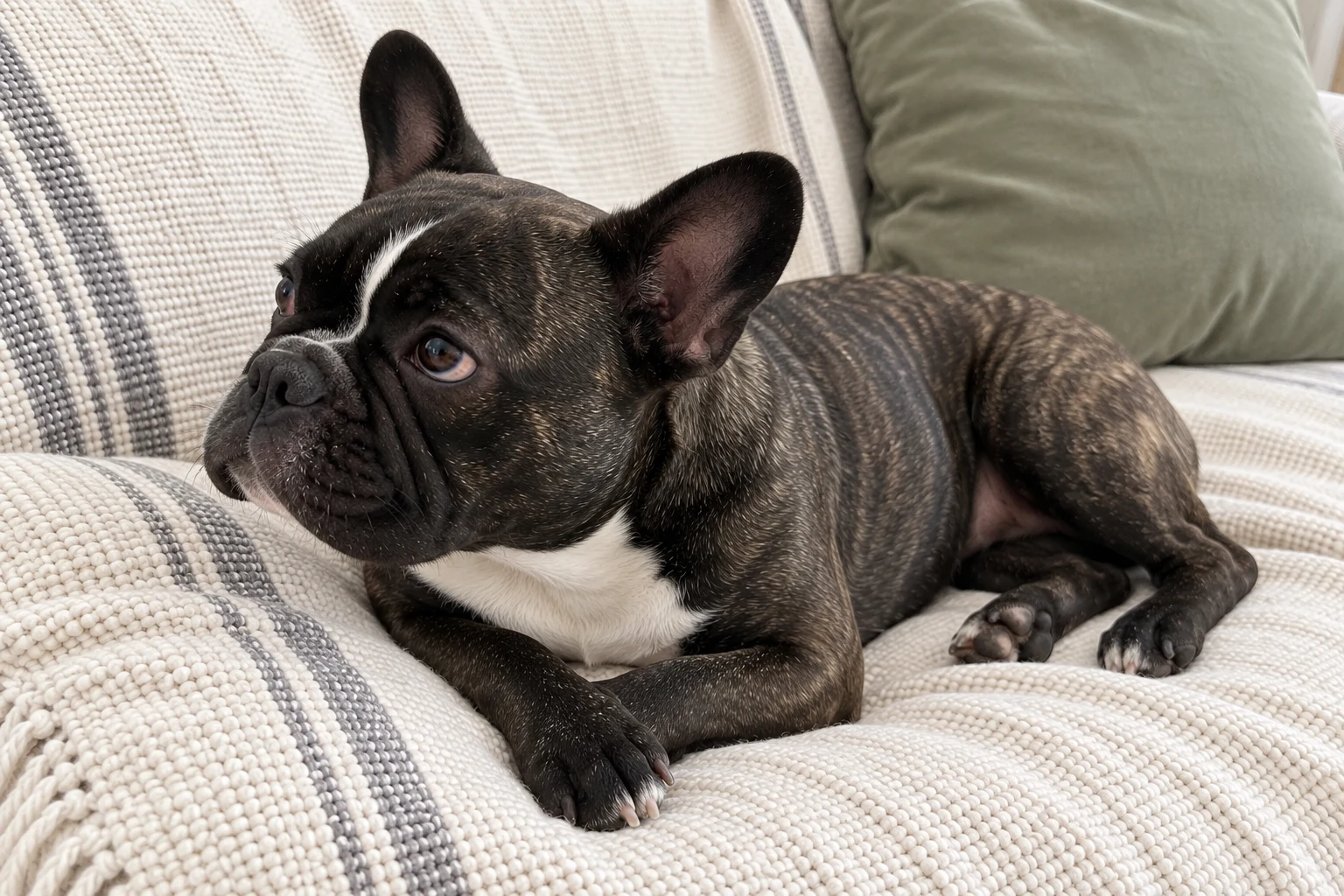

A French Bulldog mix is a dog with French Bulldog ancestry and ancestry from another breed or breeds. Frenchtons, Frugs and French Boodles all fall under that broad description, but they do not share one standard size, coat or personality.
This guide compares the questions each cross raises. For day-to-day basics, our French Bulldog care guide gives useful background; a mixed dog’s routine still needs to fit its own body, behavior and health.
Key takeaways
- French Bulldog mixes vary widely; a nickname cannot predict adult size, temperament or grooming needs.
- Crossbreeding does not guarantee better breathing or freedom from inherited disease.
- Compare the individual dog’s health, behavior and care needs, and ask for verifiable records before choosing.
French Bulldog mixes at a glance
The names below are informal, and sellers may use different spellings. This is a comparison of parentage and practical checks, not a ranking of the healthiest or friendliest mix. Fixed weight ranges would imply more certainty than these crosses allow.
| Other parent | Names you may see | What to check |
|---|---|---|
| Boston Terrier | Frenchton, Frenchbo | Both parents are flat-faced breeds. Ask about breathing assessment rather than assuming an automatic improvement. |
| Shih Tzu | French Bull Tzu, French Bullshih | Coat maintenance, eye care and the individual dog’s airway; do not assume an easy short coat. |
| Dachshund | French Bull Weiner | Body proportions, back history and an appropriate activity routine. |
| Corgi | Frorgi, French Corgi | Which Corgi breed is involved, adult build, activity needs and vocal behavior. |
| Pitbull-type dog | French pitbull, French Bullpit | The actual parent breed, strength, behavior with other pets and housing rules. |
| English Bulldog | Free-Lance Bulldog | Breathing, mobility, skin folds and both parents’ screening records. |
| Pomeranian | French Pomerdog, Frenchpomer | Coat density, brushing needs, adult size and barking in the intended home. |
| Poodle | French Boodle, Froodle | Poodle size, coat care and actual shedding; a Poodle parent does not guarantee an allergy-friendly dog. |
| Pug | Frug | Both sides are flat-faced; prioritize airway, eye and body-condition checks. |
| Chihuahua | French Bullhuahua, French Chi | Adult size, dental care, handling comfort and compatibility with the household. |
Frenchton, French Boodle or Frug: what the names tell you
Frenchton: French Bulldog and Boston Terrier
Frenchton is one of the names you will encounter frequently when researching Frenchie crosses. It identifies the intended parent breeds, not a standard outcome. A dog may have a different build from a French Bulldog, but Boston Terriers are also brachycephalic. A Frenchton should not be sold as a guaranteed solution to breathing problems.
French Boodle: French Bulldog and Poodle
“Frenchie doodle” usually points to the Poodle cross, rather than French Bulldog mixes as a whole. Ask whether the Poodle parent is Toy, Miniature or Standard; leaving that out makes size estimates especially unhelpful. Coat texture and grooming workload vary, and a curly coat can still require substantial maintenance.
Frug: French Bulldog and Pug
A Frug combines two flat-faced breeds. The cross does not remove the need to assess breathing and eye health. Look at the dog’s comfort during ordinary activity and ask a veterinarian what examinations are appropriate, rather than choosing by facial wrinkles or a particularly short nose.
Are French Bulldog mixes healthier?
There is no sound basis for promising that every Frenchie mix is healthier than a purebred French Bulldog. Different crosses can change inherited risks, but “mixed” is not a medical clearance.
A 2024 study of Cockapoos, Labradoodles and Cavapoos found no overall clear health advantage across the conditions examined compared with their parent breeds. Those were not Frenchie crosses, so the study cannot rank Frenchtons or Frugs. It does show why broad designer-dog health claims deserve scrutiny.
For flat-faced dogs, airway problems can involve internal structures as well as nostrils. A longer muzzle may be a useful physical difference, but it cannot show every obstruction. Persistent breathing noise, trouble with mild exercise or disturbed sleep should be discussed with a vet. Breathing distress or collapse is an emergency.
Ask about relevant screening for both parent breeds. Depending on the ancestry and individual dog, the discussion may include airways, eyes, joints, spine or inherited conditions identified through appropriate testing. A DNA panel and a routine puppy examination answer different questions; neither guarantees lifelong health.
Size, energy and grooming: choose for your actual home
A small parent does not guarantee a small puppy, and a cuddly description does not guarantee a quiet apartment dog. Make a short list of the things your home can realistically accommodate:
- Space and access. Consider stairs, lifting the dog when necessary, vehicle space and any housing weight restrictions.
- Daily activity. Ask how the dog behaves on walks and at home. Do not substitute a parent-breed stereotype for observed needs.
- Grooming. Longer or denser coats may require more brushing and professional care than a short Frenchie coat.
- Other pets and children. Seek specific history and arrange supported introductions. Supervise interactions and provide separate resting spaces.
- Costs. Budget for routine veterinary care, unexpected illness, grooming and training. Request insurance quotes for the actual dog.
An adult fostered dog can give you more information about size and household behavior than a puppy photo. A foster report is still a snapshot in one setting, so allow for a settling-in period and ask what has not yet been tested.
Questions to ask a breeder or rescue
- What evidence supports the ancestry description, and what is unknown?
- What medical records and relevant parent health-screening results can I see?
- How does the dog respond to handling, visitors, being alone and other animals?
- Has the dog shown breathing difficulty, limited exercise tolerance or mobility problems?
- What support and return arrangements are provided if the placement does not work?
When buying a puppy, ask to see where it is raised and meet its mother when appropriate. The father may live elsewhere; what matters is verifiable information rather than insisting both parents always be on site. Our breeder-vetting guide explains the questions behind a meaningful health claim. Avoid pressure to pay before you can review records.
FAQs about French Bulldog mixes
What is the best French Bulldog mix?
There is no universal winner. The best fit depends on the individual dog’s health, behavior and care needs, plus your home and budget. A Frenchton label is not proof of better breathing, and a Poodle cross is not proof of easy grooming.
What are French Bulldogs mixed with?
Modern Frenchie crosses may involve Boston Terriers, Pugs, Poodles, Chihuahuas and many other breeds. A purebred French Bulldog is an established breed, not simply the result of crossing two modern breeds today.
How big do French Bulldog mixes get?
There is no single adult range for all Frenchie crosses. Identify the other parent breed and size, review family information if available, and allow for uncertainty. Measure an adult dog rather than relying on a nickname.
How much does a French Bulldog mix cost?
Prices and adoption fees vary widely. Ask for a written breakdown of fees and included care, and compare lifetime costs. A “designer” name or rare color is not evidence of responsible breeding.
Do French Bulldog mixes shed?
They can. The amount and grooming routine vary with coat type. Do not rely on a Poodle or Shih Tzu parent to guarantee a non-shedding or hypoallergenic dog.
Are French Bulldog mixes good apartment dogs?
Some are, if their exercise, enrichment, toileting and social needs can be met. Check vocal behavior, comfort when alone and stair access. Size by itself does not determine apartment suitability.
Can French Bulldog mixes swim?
Do not assume a mixed dog is a capable swimmer. Use close supervision and appropriately fitted flotation near water, provide an easy exit and never force a dog into the water. Ask your vet about restrictions for a dog with breathing or mobility problems.