The original French Bulldog wasn’t one perfectly uniform dog. Small English Bulldogs became popular companions, crossed the Channel with lace workers, and developed into a distinct breed in France. American enthusiasts later helped make the upright bat ear its signature.
That history explains the family resemblance, but today’s Frenchie isn’t simply a miniature version of today’s English Bulldog. If you’re comparing the two as pets, look at their differences in size, handling and everyday care alongside the shared ancestry.
Key takeaways
- French Bulldogs developed as companions from small English Bulldogs, with their distinct breed identity shaped in France.
- Early dogs varied; historical pictures cannot establish a universal muzzle length or prove better health.
- For a modern Frenchie, prioritize documented health screening and comfortable breathing over “original” or “retro” marketing.
What were French Bulldogs bred for?
Companionship is the clearest answer. The French Bull Dog Club of America’s breed account describes Nottingham lace workers keeping small Bulldogs as lap pets. When workers moved to France, their dogs went too.
Ratting appears in breed histories as well: the French Bulldog Club of England describes toy Bulldogs chasing rats around the workers’ quarters. That doesn’t make the modern Frenchie a specialist hunting breed. A small dog could be a companion and catch a rat without having the breeding history of a purpose-developed hunting terrier.
The larger Bulldog ancestors had a connection to bull-baiting, but that is a different chapter. French Bulldog history shouldn’t turn every modern Frenchie into a former fighting dog, any more than an occasional chase in the garden proves a dog was bred to hunt.
From English toy Bulldogs to the bouledogue français
The American Kennel Club’s history traces the breed through English toy Bulldogs, displaced lace workers and life in France. Small Bulldogs found homes across Parisian society, from working households to artists and fashionable circles. Wealthy American visitors then helped introduce them to the United States.
“English roots, French development” is more accurate than saying the French Bulldog is secretly English. The FCI breed standard names France as its country of origin and places the development of the recognizable Parisian breed in the 1880s. It records a French breed club in 1880, registration in 1885 and French recognition in 1898.
These dates describe different milestones. There was no single afternoon when somebody crossed two dogs and produced the finished breed.
What two breeds make a French Bulldog?
There isn’t a reliably documented two-breed recipe. Small English Bulldogs are central to the history; accounts of other local dogs and terrier influence are less precise. The French standard describes several crossings rather than identifying two modern breeds as the definitive parents.
Claims that every Frenchie is exactly an English Bulldog crossed with a Pug, or with one particular terrier, make a complicated history sound much tidier than the records support. Today’s French Bulldog is an established breed. Crossing two other breeds now does not recreate a registered Frenchie.
Why did bat ears become the Frenchie’s trademark?
Early French Bulldogs included dogs with erect ears and dogs with folded rose ears. American fanciers strongly preferred the upright version. According to the FBDCA’s historical account, the controversy over judging rose-eared dogs at Westminster helped spur the American club’s formation in 1897.
Another dispute followed in 1898. American exhibitors withdrew, and the club staged its own bat-ear-only specialty show at the Waldorf-Astoria. The winner was a brindle dog called Dimboolaa. The familiar ear shape had enthusiastic advocates long before Frenchies appeared in social-media feeds.
Bat ears already existed; Americans didn’t invent them. Their influence was in selecting and defending them as a defining breed feature.
The original French Bulldog vs now
Old pictures are useful, but a viral “then and now” pair is a poor substitute for a representative record. Check whether the earlier dog is a French Bulldog, a toy Bulldog or another Bulldog ancestor, and whether the image has a trustworthy date and source.
| Feature | Early development | Modern French Bulldog |
|---|---|---|
| Breed identity | A developing population of small Bulldogs, later a distinct French breed | An established breed with written standards |
| Ears | Both bat and rose ears occurred | Erect bat ears are a defining feature |
| Face and build | Short-faced dogs with variation; no single historical measurement describes them all | A short-faced, compact dog; individuals differ in how exaggerated their features are |
| Purpose | Companionship, with rat-catching mentioned in some accounts | Primarily companionship |
| Health evidence | No comparable veterinary dataset establishes the health of all early Frenchies | Modern studies document important breed-related health risks |
The current FCI standard asks for balanced proportions without exaggeration and nostrils that allow normal nasal breathing. It is therefore misleading to describe the most extreme face seen online as the only legitimate modern Frenchie shape.
What the history can, and can’t, tell us about health
There are sound reasons to worry about exaggerated flat-faced anatomy. A 2021 Royal Veterinary College study compared French Bulldogs with other dogs in UK veterinary records and found increased risk for numerous conditions, including narrowed nostrils, breathing problems and skin-fold disease.
That is evidence about modern dogs. It doesn’t measure the health of Frenchies from the 1890s. In fact, the FBDCA’s history also mentions earlier difficulties with natural birth and summer heat. “They used to be completely healthy” is too sweeping.
The same caution applies to a longer-looking muzzle. In an owner discussion about Frenchie nose length, questions about appearance quickly became claims about breathing and breed identity. Those are understandable concerns, but a photograph cannot settle them.
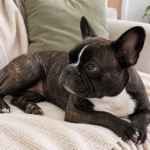
Nina belongs to the modern breed; an old portrait cannot tell us how comfortably she, or any other Frenchie, breathes. The University of Cambridge explains that BOAS assessment includes veterinary evaluation of respiratory function, and some affected dogs may show little difficulty while resting. Ask your vet about appropriate assessment rather than testing exercise tolerance yourself.
If your dog is noisy, struggling with activity or having trouble sleeping comfortably, focus on the signs of French Bulldog breathing problems. A nostalgic label doesn’t make those signs harmless.
What does “retro” or “old-style” French Bulldog mean?
Ask the seller to explain it. The label may describe a goal of less exaggerated features, a particular breeding line, or a crossbreed. It isn’t a veterinary finding or, by itself, evidence of the dog’s ancestry.
Look for identifiable parents, actual screening results, breathing assessments and a clear explanation of the mating. A longer muzzle can be a reason to ask useful questions. It cannot replace the answers, and it doesn’t establish that the breeder has recreated a specific nineteenth-century dog.
FAQs about the original French Bulldog
Are French Bulldogs French?
Yes, France is their recognized country of origin. Their English toy-Bulldog roots and later American influence are also important parts of the breed’s development.
Were French Bulldogs bred to fight?
The French Bulldog developed as a companion. Its larger Bulldog ancestors were associated with bull-baiting, but ancestry is not the same as the purpose of the later French breed.
Did original French Bulldogs have longer noses?
Early dogs varied. A particular dated image may show a less shortened muzzle than a particular modern dog, but the records don’t support one universal “original” nose length or a health diagnosis from appearance.
Are French Bulldogs hunting dogs?
They are classified as companions. Rat-catching appears in some historical accounts, but French Bulldogs aren’t generally classified as specialist hunting dogs.
What kind of dog is a Frenchie?
“Frenchie” is a nickname for the French Bulldog. The FCI classification places the breed among Companion and Toy Dogs, in the small Molossian section. It is a domestic dog breed, not a separate animal species.
What does a French Bulldog bloodline tell you?
A documented pedigree identifies recorded ancestors. It doesn’t guarantee temperament, comfortable breathing or future health. Ask for health results as well as the family tree.
When did French Bulldogs become popular in America?
They attracted American admirers in the late nineteenth century and appeared at Westminster in the 1890s. Their popularity has risen and fallen since; the recent boom isn’t their first fashionable period.
Were the original French Bulldogs healthier?
There isn’t an equivalent historical veterinary dataset to make that comparison. Today’s health risks are well documented, and avoiding exaggerated anatomy matters, but “old” is not a health certificate.