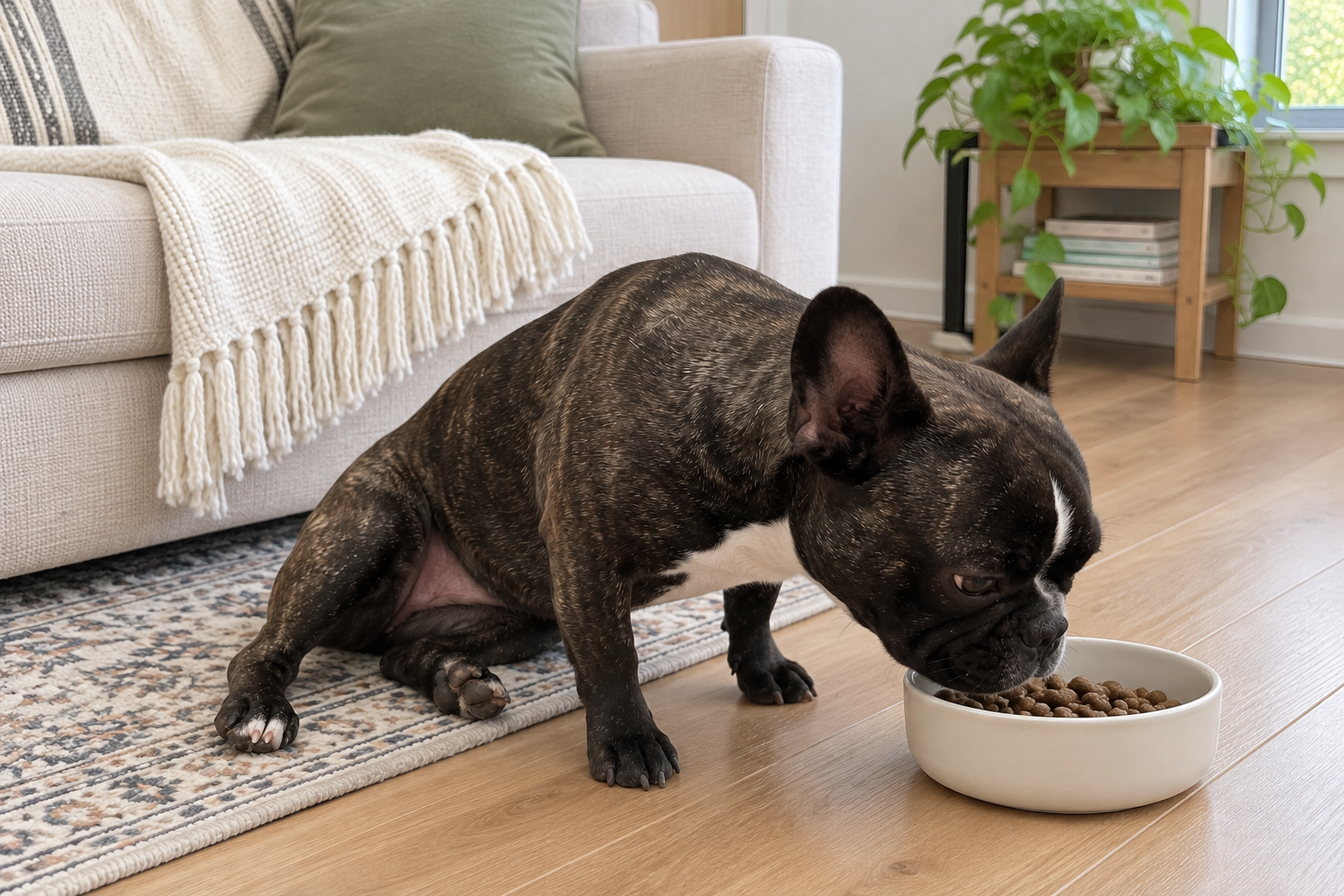

For about a year I thought Nina just had “sensitive skin.” The vet and I kept circling it, new shampoo, wipe the folds more, maybe it’s the season. Then we actually looked at her food, which, like roughly every dog food on the shelf, was built on chicken. Pull the chicken, and a lot of the drama went with it. I’m not saying that’s the answer for every Frenchie. That improvement was worth discussing with our vet; by itself, it did not prove chicken was the cause. If your Frenchie has persistent paw licking or itchy skin, the useful next step is an investigation, not a string of random food swaps.
Key takeaways
- Some Frenchies react to chicken; the breed does not need blanket avoidance.
- Itching, ear problems and digestive upset have several possible causes.
- A vet-directed elimination diet and planned challenge can investigate food allergy; a quick swap or online test cannot confirm it.
So, are French Bulldogs allergic to chicken?
Some French Bulldogs can be allergic to chicken, but it is not something to assume from breed alone. A dog doing well on a complete chicken-containing diet does not need an automatic change just because other owners avoid it.
In a review of reports covering 297 dogs with adverse food reactions, beef, dairy, chicken and wheat were commonly reported triggers. It was not a French Bulldog-only study and did not establish chicken as this breed’s number-one allergen. Those percentages also do not describe the chance that any healthy dog will become allergic.
My vet’s framing stuck with me: suspect it, but prove it before you rebuild the whole diet around avoiding it. An ingredient being inexpensive or processed does not establish an allergy, and paying more for chicken does not make it suitable for a dog with a confirmed reaction to chicken protein.
What a chicken allergy actually looks like
Food allergies in Frenchies show up on the skin far more than people expect. Watch for:
- Itchy skin, with scratching, chewing, or rubbing against furniture
- Obsessive licking or chewing of the paws (often the first thing owners notice)
- Recurring ear infections, red, smelly, or waxy ears that keep coming back
- Red or inflamed skin, hot spots, and irritation in the folds
- Skin or ear changes that persist or return despite basic care
- Digestive upset, loose stools, gas, or occasional vomiting
These signs are not specific to chicken or even to food allergy. Parasites, infection, environmental allergies and other problems can overlap. Persistent symptoms deserve an examination; painful, squinting or discharging eyes need their own assessment rather than being explained away as food allergy.
Chicken allergy vs. sensitive stomach vs. environmental
Food intolerance and other digestive conditions can cause stomach symptoms without the same immune mechanism as allergy. Food allergy can involve skin, ears and sometimes digestion. Environmental allergies can look similar and may be seasonal or year-round.
UC Davis notes that allergy causes can overlap. A seasonal pattern is useful history, not a complete diagnosis; improvement after a diet change also needs interpretation alongside other treatment and changing exposures.
How to actually find out (the elimination diet)
Ask your vet to choose an appropriate complete elimination diet from your dog’s full food history. That may be a veterinary hydrolyzed diet or a suitable novel-protein diet. “Novel” means new to your individual dog; turkey or salmon is not automatically suitable just because it is different from the current bag.
AAHA describes a strict trial typically lasting 8–12 weeks. Your vet sets the duration and rechecks. Treats, chews, table scraps and flavored medicines need to be considered too; do not stop prescribed medicine yourself.
The discipline is the hard part. One chicken-flavored chew from a well-meaning houseguest can make the result harder to interpret. Keep a simple record of food, symptoms and any accidental extras, then tell the vet rather than silently restarting.
If signs improve, the vet may plan a controlled challenge to confirm the suspected food reaction. Improvement alone is not proof. Blood, saliva and hair panels do not replace this process for diagnosing food allergy, as the AAHA allergy guidelines explain.
What to feed instead
Once the cause is established, choose a complete diet your dog tolerates with your vet. Chicken-free, grain-free and limited-ingredient are different claims; none automatically means appropriate for a diagnostic trial. A short ingredient list does not guarantee that a food avoids the relevant trigger.
Our sensitive-stomach food comparison covers different options, but digestive tolerance and a confirmed allergy are not interchangeable. Likewise, food choices for gassy Frenchies should follow the cause of the symptoms, not a promise that one protein fixes both problems. Read the complete label, including treats and supplements.
When to call the vet
Book an examination before repeated diet experiments, especially for recurring ear infections, damaged skin or ongoing vomiting or diarrhea. These problems may need treatment while the underlying cause is investigated. Sudden breathing difficulty, collapse or facial swelling warrants urgent veterinary help.
Bring food and treat names, photos of skin changes, a timeline and details of anything already tried. A food previously tolerated can still be relevant, but the history does not prove a specific allergy on its own.
FAQs about French Bulldogs and chicken allergies
Can French Bulldogs eat chicken?
Chicken can be part of a suitable complete diet for a Frenchie who tolerates it. There is no breed-wide rule to avoid it. If your dog has symptoms, ask your vet to investigate before removing ingredients at random.
How do I know if my Frenchie is allergic to chicken?
Symptoms alone cannot identify chicken as the trigger. A vet-directed elimination diet followed by an appropriate challenge is used to investigate food allergy. Keep a symptom record and disclose all treats, chews and medicines.
What are the most common French Bulldog food allergens?
The cited research reports common triggers in dogs generally, including beef, dairy, chicken and wheat; it does not provide a reliable Frenchie-specific ranking. Your dog’s own history and diagnostic results matter more than that list.
How long does it take for a chicken allergy to show up?
A reaction may develop after a food was previously tolerated, and timing varies. New itching does not identify chicken on its own. Discuss the full pattern with your vet, including diet changes, season and skin or ear treatments.
Is a grain allergy more common than chicken in Frenchies?
The available general-dog evidence does not establish a Frenchie-specific comparison. Both animal proteins and some plant ingredients can be triggers. Grain-free is not a diagnosis or a substitute for identifying the individual allergen.
Will switching to salmon food cure the itching?
Not necessarily. Salmon may be unsuitable for some dogs, and the itch may have a non-food cause or several causes. A retail food swap also changes multiple ingredients at once, making it difficult to isolate what helped.
What are French Bulldogs not allowed to eat?
Beyond your dog’s own allergens, never give a Frenchie the foods that are toxic to all dogs: chocolate, grapes and raisins, onions and garlic, xylitol (in sugar-free gum and some peanut butters), macadamia nuts, and alcohol. Fatty table scraps are a bad idea too for a breed that gains weight and gets upset stomachs easily.
Are Frenchies allergic to beef and turkey too?
They can react to proteins other than chicken. Beef is commonly reported in general-dog studies; turkey is not automatically a safe substitute or a novel protein for every dog. Let the vet choose a trial diet using the full history.