
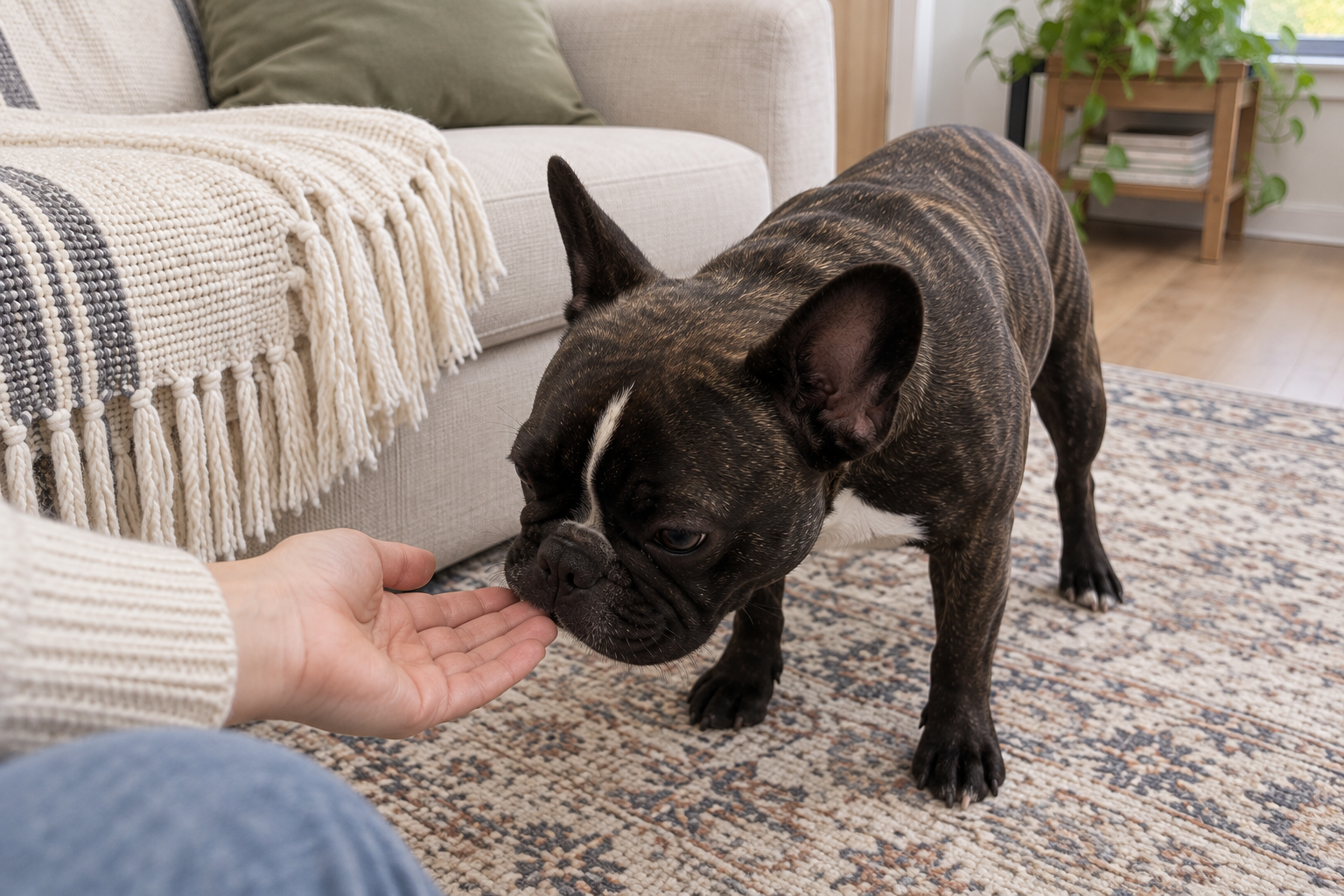

Nina failed “roll over” for three straight weeks. The same dog worked out that the click of my laptop lid means a walk might be on the table, and now materializes at the front door before I’ve finished standing up. She has also trained three separate humans to dispense snacks using nothing but eye contact and a strategic sigh.
So when people ask if French Bulldogs are smart, my honest answer is: which kind of smart are we measuring? Nina learns plenty of things that matter to her, even when a trick takes us longer.
Key takeaways
- Frenchies can learn routines, cues and useful everyday skills.
- Obedience rankings measure a limited part of ability, not your dog’s entire intelligence.
- If a cue is not working, check understanding, distractions and comfort. Use short, reward-based sessions instead of assuming deliberate defiance.
So, are French Bulldogs smart?
Yes: French Bulldogs can learn, solve everyday problems and build useful habits. How quickly an individual learns a particular task varies. Nina noticing my laptop lid or fetching me when she wants help tells me something about her learning; it does not establish that Frenchies outperform other breeds in social intelligence.
A dog who needs more practice with one cue may be very good at another task. “Smart” is most helpful when we say what the dog actually did, rather than turn a breed stereotype into a score.
About those intelligence rankings
The much-quoted list in Stanley Coren’s The Intelligence of Dogs concerns working and obedience performance. In his explanation of the method, Coren describes questionnaires sent to obedience judges. That is different from giving every individual dog a general intelligence test.
A ranking does not tell you why Nina learned one routine quickly and another slowly. Nor does a modest obedience result prove that a companion dog cannot learn. Treat a list as context about a particular measure, not a ceiling on what you can teach.
Where Frenchie intelligence actually shows up
Watch a Frenchie for a week and you’ll catch the real machinery working. Nina knows the difference between the shoes that mean a walk and the shoes that mean I’m leaving without her, and she makes her displeasure known before my hand touches the leash hook, or doesn’t. She knows which human caves on couch access, which one is soft on dinner-time enforcement, and precisely how long to hold the orphan stare before someone breaks. When she wants a toy that’s under the sofa, she doesn’t paw at it for long; she comes and gets a human, walks them to the sofa, and points with her whole face.
Those are the little problem-solving moments I notice at home. I call it middle management; more literally, she has learned which actions get a response from us.
Stubborn is not stupid
Nina knows “sit” at home. Nina is much less interested in sitting on wet grass. It is tempting to describe that as negotiation, but I cannot assume every missed cue means she understands perfectly and has chosen to ignore me.
A cue may not be well learned in that setting. Distractions, uncertainty, tiredness or discomfort can also interfere. The Frenchie temperament guide gives context, but calling a dog stubborn does not tell you which part of training needs changing.
Make the next repetition easier
Practice briefly in a quiet place, reward the behavior you want and stop before either of you gets frustrated. Add distractions gradually rather than moving straight from a quiet room to a busy park. The AKC’s distraction-training guidance explains that progression.
Use a reward your dog enjoys and can comfortably eat; it does not need to be a large piece of rich food. Our training-treat comparison focuses on small portions. Food is useful, but it is not a cure for fear, pain or an exercise that is too difficult.
If excitement is the obstacle, include quiet rest and settling practice. If a familiar movement suddenly becomes difficult or your dog seems uncomfortable, ask your vet rather than pushing through.
FAQs about French Bulldog intelligence
Are French Bulldogs easy to train?
Some tasks come easily; others need more practice. Keep sessions manageable, rewards useful and instructions consistent. Work with your individual dog instead of expecting every Frenchie to learn at the same speed.
Where do French Bulldogs rank in dog intelligence?
Commonly quoted obedience lists do not place Frenchies among the leading breeds, but those lists measure a particular kind of performance. They are not an individual IQ test or a complete assessment of learning ability.
Do Frenchies bond with one person?
A Frenchie may show a preference for someone while forming relationships with several people. Routines and interactions matter. A favorite person does not mean the dog cannot learn from or enjoy time with others.
Why does my Frenchie ignore me outside?
The surroundings may be harder than the place where the cue was learned. Reduce distractions and practice in easier settings first. Also consider stress or discomfort rather than assuming the dog is deliberately refusing.
What is the smartest dog breed?
There is no single measure covering everything dogs can learn or do. Border Collies are well known for strong obedience performance, but that does not make one breed the best learner for every task or home.
What is a French Bulldog’s IQ?
There is no validated single human-style IQ number for all French Bulldogs. Describe the skill you are interested in—learning a cue, finding something or following a routine—and assess the individual dog in context.
How do you discipline a French Bulldog?
Teach and reward the behavior you want, prevent repeated practice of unwanted behavior and keep expectations clear. Avoid frightening or hurting the dog. For persistent difficulties, a qualified reward-based trainer can help you identify what is missing.