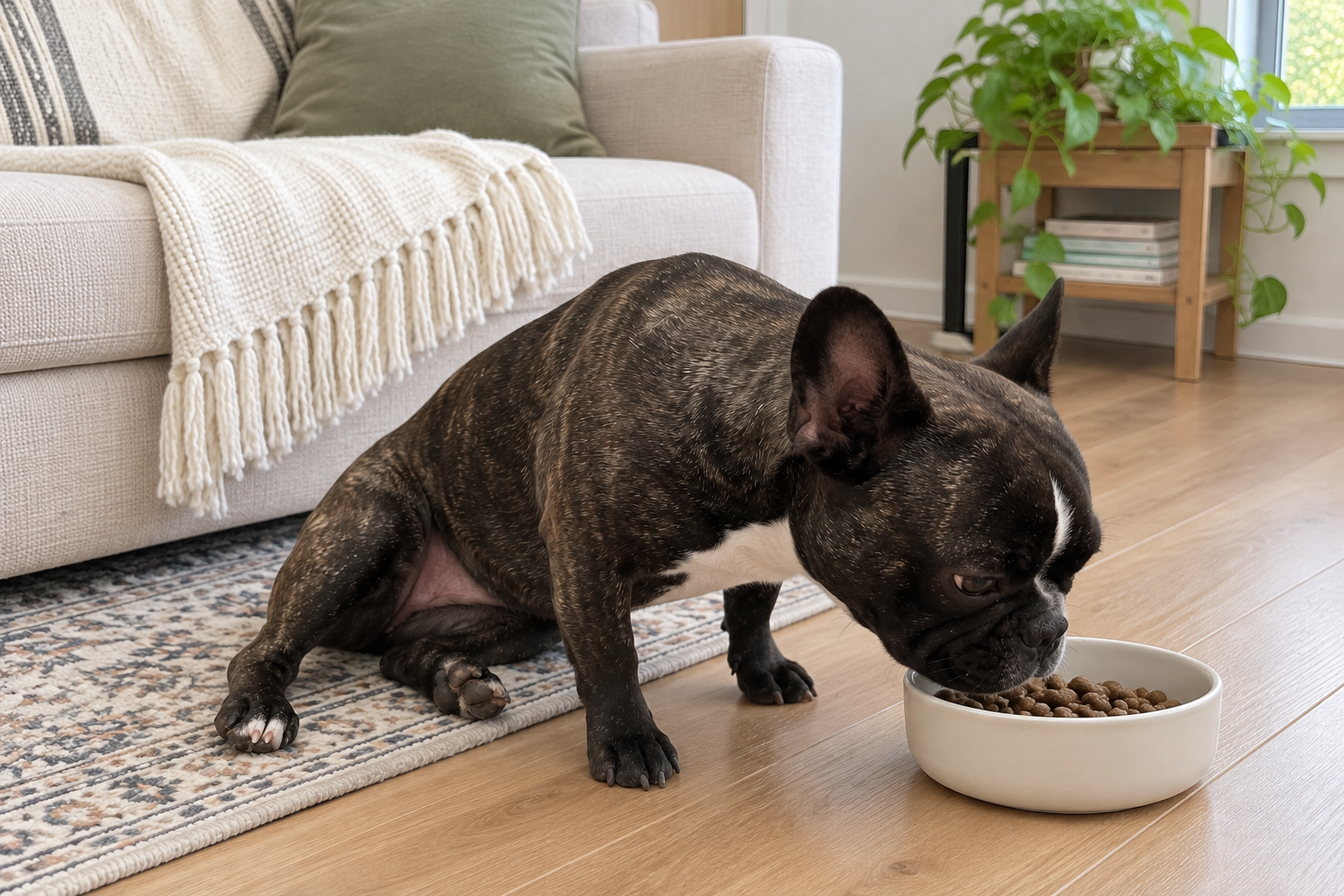

At one of Nina’s early checkups, our vet ran her hands along Nina’s ribs, looked at the chart, and asked me a question I was not expecting: how did I decide her portion? I said, with some pride, that I followed the feeding guide on the bag. She nodded the way vets nod when they are about to gently ruin your day. The useful lesson was that a bag is a starting point, not Nina’s individual prescription. A French Bulldog who naps nineteen hours a day and considers a walk to the food bowl cardio still needs a portion tailored to her own body condition and health.
That conversation changed how I feed her, and it is the framework below: start with the number, measure it honestly, and then let the dog’s actual body, not the bag, be the judge.
Key takeaways
- There is no single correct calorie allowance for every French Bulldog.
- Use your dog’s individual target and the exact food’s energy density to calculate measured portions, including treats.
- Review weight, body condition, growth and appetite with your vet. Puppies, seniors and dogs with medical needs require their own plans.
How many calories should a French Bulldog eat?
Start with your dog’s life stage, body condition, health and current intake. A label or calculator gives an estimate; follow-up shows whether it fits. A fixed calories-per-pound rule does not become exact just because you know an ideal weight.
The AAHA nutrition guidelines emphasize individual assessment and monitoring. Ask your vet for a starting daily calorie target and when to reassess it. Do not use adult weight-loss calculations for a growing puppy.
For food selection rather than quantity, see what to feed a French Bulldog. Keeping those two decisions separate makes the arithmetic easier.
Count the food outside the bowl too
A large part of our wake-up call, which I wrote about in Nina’s weight-management story, was discovering that her official portion was fine and her unofficial portion was the problem. A few rewards from several people can add up without anyone feeling they offered much.
For a smaller dog, small extras can take up a meaningful part of the day’s allowance. That does not mean every Frenchie is inactive or that every weight change is simply overeating. Record food and treats honestly and discuss unexplained changes with your vet.
Calculate daily portions in grams or cups
- Find the energy density. Read the exact recipe’s kcal/kg, kcal/cup or kcal/container. Similar-looking foods can differ.
- Subtract other food from the daily target. Count treats, toppers, chews and food used for medication.
- Convert the remaining calories. For grams, divide kcal/kg by 1,000, then divide the meal-food allowance by kcal/g. For cups, divide by kcal/cup.
- Weigh and split the daily amount. A kitchen scale makes grams easier to repeat. Use the meal schedule suited to your dog.
- Monitor and review. Keep a weight and body-condition record and follow the agreed adjustment plan. Stool quality alone cannot prove that the amount or recipe is right.
Worked example, not a prescription: a hypothetical 600-calorie daily target with 40 calories of treats leaves 560 calories for food. At 3,500 kcal/kg, that is 560 ÷ 3.5 = 160 grams daily, or 80 grams at each of two meals. Use your own dog’s target and label instead of copying these numbers.
Feeding schedules for puppies, adults and seniors
Young puppies commonly need several small meals, with the amount and frequency reviewed as they grow. Use an appropriate puppy food and follow the puppy’s own plan. Our growth guide explains tracking the trend rather than aiming for a breed-wide monthly weight.
Two meals is a practical adult routine for many households, but health and individual needs may call for another schedule. Seniors do not automatically need fewer calories: appetite, muscle, body condition and illness all matter.
For mixed feeding, add the calories from both foods. A wet-food portion cannot be exchanged gram-for-gram with kibble without checking energy density. Follow prescribed-diet instructions when ordinary treat substitutions are unsuitable.
FAQs about how much a French Bulldog should eat
How many cups of food should a French Bulldog eat a day?
Divide the calories allocated to that food by its kcal per cup. Without the exact label and individual allowance, a cup range is guesswork.
How much should a French Bulldog eat in grams?
Divide the food’s kcal/kg by 1,000 to get kcal/g, then divide the allocated daily calories by that value. Weigh the resulting daily portion and split it into meals.
How often should I feed my French Bulldog?
Many adults eat two meals daily, while young puppies commonly need more frequent small meals. Follow an individual plan for growth or medical needs.
Why is my French Bulldog always hungry?
Food-seeking can be learned, but do not dismiss a new or marked appetite change as acting. Record intake and seek veterinary advice, especially with weight loss, increased thirst or other changes.
How many calories does a French Bulldog need per day?
There is no exact breed-wide figure. Your vet can estimate a starting target from the individual dog and review the response; a calculator cannot replace that follow-up.
Should I free-feed my French Bulldog?
Measured portions help you track intake and spot changes. Discuss the schedule with your vet if your dog has special needs rather than keeping an unmeasured bowl full.
How do I know if I am overfeeding my Frenchie?
Review the full intake alongside weight and body condition. Ask your vet to demonstrate the assessment and agree on adjustments; do not sharply restrict a puppy or assume every weight change is excess food.
Can my Frenchie eat once a day?
Some individual plans differ, but two meals is a practical starting routine for many adults. Puppies and dogs with medical needs may require more frequent feeding; check before changing the schedule.